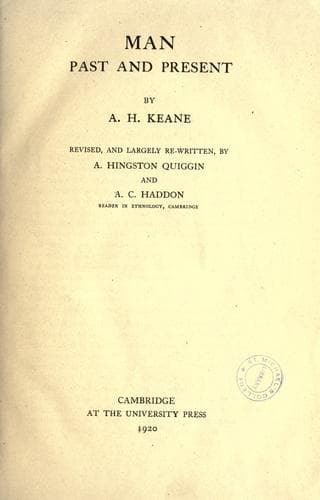
Man, Past and PresentKeane, A. H. (Augustus Henry)
History
Man, Past and Present
Keane, A. H. (Augustus Henry)
Anthropology; Ethnology
It is especially in this obscure field of research that the eminent
Danish scholar, Vilhelm Thomsen, has rendered inestimable services to
European ethnology. By the light of his linguistic studies A. H.
Snellman[716] has elucidated the origins of the Baltic Finns, the
Proto-Esthonians, the now all but extinct Livonians, and the quite
extinct Kurlanders, from the time when they still dwelt east and
south-east of the Baltic lands, under the influence of the surrounding
Lithuanian and Gothic tribes, till the German conquest of the Baltic
provinces. We learn from Jordanes, to whom is due the first authentic
account of these populations, that the various Finnish tribes were
subject to the Gothic king Hermanarich, and Thomsen now shows that all
the Western Finns (Esthonians, Livonians, Votes, Vepses, Karelians,
Tavastians, and others of Finland) must in the first centuries of the
new era have lived practically as one people in the closest social
union, speaking one language, and following the same religious, tribal,
and political institutions. Earlier than the Gothic was the
Letto-Lithuanian contact, as shown by the fact that its traces are
perceptible in the language of the Volga Finns, in which German
loan-words are absent. From these investigations it becomes clear that
the Finnish domain must at that time have stretched from the present
Esthonia, Livonia, and Lake Ladoga south to the western Dvina.
The westward movement was connected with the Slav migrations. When the
Slavs south of the Letts moved west, other Slav tribes must have pushed
north, thus driving both Letts and Finns west to the Baltic provinces,
which had previously been occupied by the Germans (Goths). Some of the
Western Finns must have found their way about 500 A.D., scarcely
earlier, into parts of this region, where they came into hostile and
friendly contact with the Norsemen. These relations would even appear to
be reflected in the Norse mythology, which may be regarded as in great
measure an echo of historic events. The wars of the Swedish and Danish
kings referred to in these oral records may be interpreted as plundering
expeditions rather than permanent conquests, while the undoubtedly
active intercourse between the east and west coasts of the Baltic may be
explained on the assumption that, after the withdrawal of the Goths, a
remnant of the Germanic populations remained behind in the Baltic
provinces.
Public-domain text, read in full here on John Shaqi.
Reviews
Reviews
No reviews yet
Be the first to share your thoughts on this work.
Elsewhere in the archive
Join the Discussion
Join the discussion
Sign in to leave a comment or review.
Sign InorCreate an account