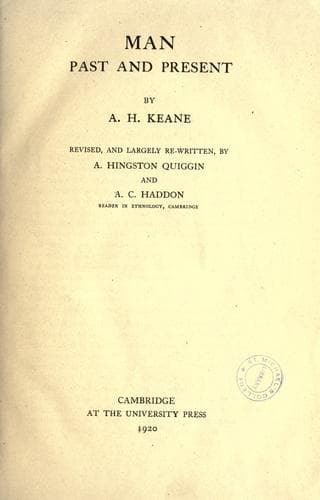
Man, Past and PresentKeane, A. H. (Augustus Henry)
History
Man, Past and Present
Keane, A. H. (Augustus Henry)
Anthropology; Ethnology
Very different are the tall, slim, active Karelians (_Karialaiset_,
"Cowherds," from _Kari_, "Cow"), with more regular features, straight
grey eyes, brown complexion, and chestnut hair, like that of the hero of
the Kalevala, hanging in ringlets down the shoulders. Many of the
Karelians, and most of the neighbouring _Ingrians_ about the head of the
Gulf of Finland, as well as the Votes and Vepses of the great lakes,
have been assimilated in speech, religion, and usages to the surrounding
Russian populations. But the more conservative Tavastians have hitherto
tenaciously preserved the national sentiment, language, and traditions.
Despite the pressure of Sweden on the west, and of Russia on the east,
the Finns still stand out as a distinct European nationality, and
continue to cultivate with success their harmonious and highly poetical
language. Since the twelfth century they have been Christians, converted
to the Catholic faith by "Saint" Eric, King of Sweden, and later to
Lutheranism, again by the Swedes[720]. The national university, removed
in 1827 from Abo to Helsingfors, is a centre of much scientific and
literary work, and here E. Loennrot, father of Finnish literature,
brought out his various editions of the _Kalevala_, that of 1849
consisting of some 50,000 strophes[721].
A kind of transition from these settled and cultured Finns to the Lapps
of Scandinavia and Russia is formed by the still almost nomad, or at
least restless _Kwaens_, who formerly roamed as far as the White Sea,
which in Alfred's time was known as the _Cwen Sae_ (Kwaen Sea). These
Kwaens, who still number nearly 300,000, are even called nomads by J. A.
Friis, who tells us that there is a continual movement of small bands
between Finland and Scandinavia. "The wandering Kwaens pass round the
Gulf of Bothnia and up through Lappmarken to Kittalae, where they
separate, some going to Varanger, and others to Alten. They follow the
same route as that which, according to historians, some of the Norsemen
followed in their wanderings from Finland[722]." The references of the
Sagas are mostly to these primitive Bothnian Finns, with whom the
Norsemen first came in contact, and who in the sixth and following
centuries were still in a rude state not greatly removed from that of
their Ugrian forefathers. As shown by Almqvist's researches, they lived
almost exclusively by hunting and fishing, had scarcely a rudimentary
knowledge of agriculture, and could prepare neither butter nor cheese
from the milk of their half-wild reindeer herds.
Public-domain text, read in full here on John Shaqi.
Reviews
Reviews
No reviews yet
Be the first to share your thoughts on this work.
Elsewhere in the archive
Join the Discussion
Join the discussion
Sign in to leave a comment or review.
Sign InorCreate an account