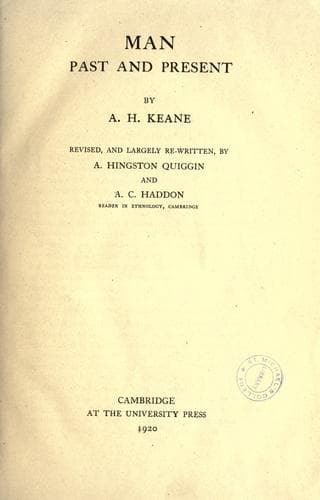
Man, Past and PresentKeane, A. H. (Augustus Henry)
History
Man, Past and Present
Keane, A. H. (Augustus Henry)
Anthropology; Ethnology
Such were also, and in some measure still are, the kindred Lapps, who
with the allied _Yurak Samoyeds_ of Arctic Russia are the only true
nomads still surviving in Europe. A. H. Cocks, who travelled amongst all
these rude aborigines in 1888, describes the Kwaens who range north to
Lake Enara, as "for the most part of a very rough class," and found that
the Russian Lapps of the Kola Peninsula, "except as to their clothing
and the addition of coffee and sugar to their food supply, are living
now much the same life as their ancestors probably lived 2000 or more
years ago, a far more primitive life, in fact, than the Reindeer Lapps
[of Scandinavia]. They have not yet begun to use tobacco, and reading
and writing are entirely unknown among them. Unlike the three other
divisions of the race [the Norwegian, Swedish, and Finnish Lapps], they
are a very cheerful, light-hearted people, and have the curious habit
of expressing their thoughts aloud in extempore sing-song[723]."
Similar traits have been noticed in the Samoyeds, whom F. G. Jackson
describes as an extremely sociable and hospitable people, delighting in
gossip, and much given to laughter and merriment[724]. He gives their
mean height as nearly 5 ft. 2 in., which is about the same as that of
the Lapps (Von Dueben, 5 ft. 2 in., others rather less), while that of
the Finns averages 5 ft. 5 in. (Topinard). Although the general Mongol
appearance is much less pronounced in the Lapps than in the Samoyeds, in
some respects--low stature, flat face with peculiar round outline--the
latter reminded Jackson of the Ziryanians, who are a branch of the
Beormas (Permian Finns), though like them now much mixed with the
Russians. The so-called prehistoric "Lapp Graves," occurring throughout
the southern parts of Scandinavia, are now known from their contents to
have belonged to the Norse race, who appear to have occupied this region
since the New Stone Age, while the Lapp domain seems never to have
reached very much farther south than Trondhjem.
All these facts, taken especially in connection with the late arrival of
the Finns themselves in Finland, lend support to the view that the Lapps
are a branch, not of the Suomalaiset, but of the Permian Finns, and
reached their present homes, not from Finland, but from North Russia
through the Kanin and Kola Peninsulas, if not round the shores of the
White Sea, at some remote period prior to the occupation of Finland by
its present inhabitants. This assumption would also explain Ohthere's
statement that Lapps and Permians seemed to speak nearly the same
language. The resemblance is still close, though I am not competent to
say to which branch of the Finno-Ugrian family Lapp is most nearly
allied.
Public-domain text, read in full here on John Shaqi.
Reviews
Reviews
No reviews yet
Be the first to share your thoughts on this work.
Elsewhere in the archive
Join the Discussion
Join the discussion
Sign in to leave a comment or review.
Sign InorCreate an account