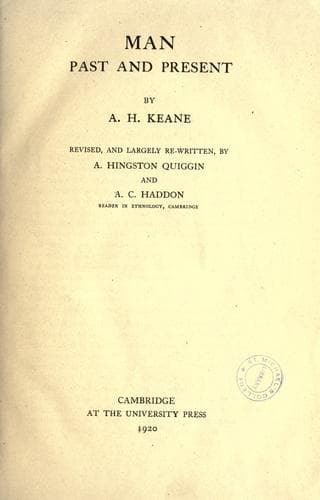
Man, Past and PresentKeane, A. H. (Augustus Henry)
History
Man, Past and Present
Keane, A. H. (Augustus Henry)
Anthropology; Ethnology
Similar beliefs and practices still prevail not only amongst the
Siberian Finns--Ostyaks of the Yenisei and Obi rivers, Voguls of the
Urals--but even amongst the Votyaks, Mordvinians, Cheremisses and other
scattered groups still surviving in the Volga basin. So recently as the
year 1896 a number of Votyaks were tried and convicted for the murder of
a passing mendicant, whom they had beheaded to appease the wrath of
Kiremet, Spirit of Evil and author of the famine raging at that time in
Central Russia. Besides Kiremet, the Votyaks--who appear to have
migrated from the Urals to their present homes between the Kama and the
Viatka rivers about 400 A.D., and are mostly heathens--also worship
Inmar, God of Heaven, to whom they sacrifice animals as well as human
beings whenever it can be safely done. We are assured by Baron de Baye
that even the few who are baptized take part secretly in these
unhallowed rites[727].
To the Ugrian branch, rudest and most savage of all the Finnish peoples,
belong these now moribund Volga groups, as well as the fierce Bulgar and
Magyar hordes, if not also their precursors, the _Jazyges_ and
_Rhoxolani_, who in the second century A.D. swarmed into Pannonia from
the Russian steppe, and in company with the Germanic Quadi and
Marcomanni twice (168 and 172) advanced to the walls of Aquileia, and
were twice arrested by the legions of Marcus Aurelius and Verus. Of the
once numerous Jazyges, whom Pliny calls Sarmates, there were several
branches--_Maeotae_, Metanastae, _Basilii_ ("Royal")--who were first
reduced by the Goths spreading from the Baltic to the Euxine and Lower
Danube, and then overwhelmed with the Dacians, Getae, Bastarnae, and a
hundred other ancient peoples in the great deluge of the Hunnish
invasion.
From the same South Russian steppe--the plains watered by the Lower Don
and Dnieper--came the _Bulgars_, first in association with the Huns,
from whom they are scarcely distinguished by the early Byzantine
writers, and then as a separate people, who, after throwing off the yoke
of the Avars (635 A.D.), withdrew before the pressure of the Khazars
westwards to the Lower Danube (678). But their records go much farther
back than these dates, and while philologists and archaeologists are
able to trace their wanderings step by step north to the Middle Volga
and the Ural Mountains, authentic Armenian documents carry their history
back to the second century B.C. Under the Arsacides numerous bands of
Bulgars, driven from their homes about the Kama confluence by civil
strife, settled on the banks of the Aras, and since that time (150-114
B.C.) the Bulgars were known to the Armenians as a great nation dwelling
away to the north far beyond the Caucasus.
Public-domain text, read in full here on John Shaqi.
Reviews
Reviews
No reviews yet
Be the first to share your thoughts on this work.
Elsewhere in the archive
Join the Discussion
Join the discussion
Sign in to leave a comment or review.
Sign InorCreate an account