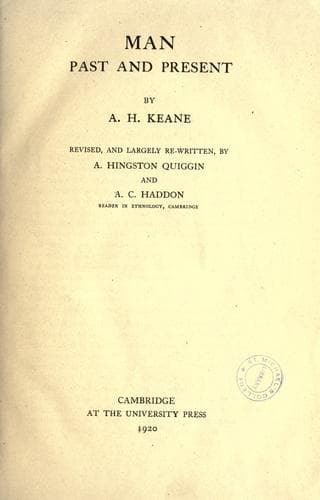
Man, Past and PresentKeane, A. H. (Augustus Henry)
History
Man, Past and Present
Keane, A. H. (Augustus Henry)
Anthropology; Ethnology
Originally the name, which afterwards acquired such an odious notoriety
amongst the European peoples, may have been more geographical than
ethnical, implying not so much a particular nation as all the
inhabitants of the _Bulga_ (Volga) between the Kama and the Caspian. But
at that time this section of the great river seems to have been mainly
held by more or less homogeneous branches of the Finno-Ugrian family,
and palethnologists have now shown that to this connection beyond all
question belonged in physical appearance, speech, and usages those bands
known as Bulgars, who formed permanent settlements in Moesia south of
the Lower Danube towards the close of the seventh century[728]. Here
"these bold and dexterous archers, who drank the milk and feasted on the
flesh of their fleet and indefatigable horses; whose flocks and herds
followed, or rather guided, the motions of their roving camps; to whose
inroads no country was remote or impervious, and who were practised in
flight, though incapable of fear[729]," established a powerful state,
which maintained its independence for over seven hundred years
(678-1392).
Acting at first in association with the Slavs, and then assuming "a
vague dominion" over their restless Sarmatian allies, the Bulgars spread
the terror of their hated name throughout the Balkan lands, and were
prevented only by the skill of Belisarius from anticipating their Turki
kinsmen in the overthrow of the Byzantine Empire itself. Procopius and
Jornandes have left terrible pictures of the ferocity, debasement, and
utter savagery, both of the Bulgars and of their Slav confederates
during the period preceding the foundation of the Bulgar dynasty in
Moesia. Wherever the Slavs (Antes, Slavini) passed, no soul was left
alive; Thrace and Illyria were strewn with unburied corpses; captives
were shut up with horse and cattle in stables, and all consumed
together, while the brutal hordes danced to the music of their shrieks
and groans. Indescribable was the horror inspired by the Bulgars, who
killed for killing's sake, wasted for sheer love of destruction, swept
away all works of the human hand, burnt, razed cities, left in their
wake nought but a picture of their own cheerless native steppes. Of all
the barbarians that harried the Empire, the Bulgars have left the most
detested name, although closely rivalled by the Slavs.
Public-domain text, read in full here on John Shaqi.
Reviews
Reviews
No reviews yet
Be the first to share your thoughts on this work.
Elsewhere in the archive
Join the Discussion
Join the discussion
Sign in to leave a comment or review.
Sign InorCreate an account