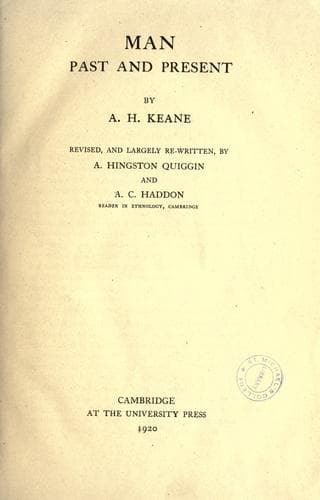
Man, Past and PresentKeane, A. H. (Augustus Henry)
History
Man, Past and Present
Keane, A. H. (Augustus Henry)
Anthropology; Ethnology
To the ethnologist the later history of the Bulgarians is of exceptional
interest. They entered the Danubian lands in the seventh century as
typical Ugro-Finns, repulsive alike in physical appearance and mental
characters. Their dreaded chief, Krum, celebrated his triumphs with
sanguinary rites, and his followers yielded in no respects to the Huns
themselves in coarseness and brutality. Yet an almost complete moral if
not physical transformation had been effected by the middle of the ninth
century, when the Bulgars were evangelised by Byzantine missionaries,
exchanged their rude Ugrian speech for a Slavonic tongue, the so-called
"Church Slav," or even "Old Bulgarian," and became henceforth merged in
the surrounding Slav populations. The national name "Bulgar" alone
survives, as that of a somewhat peaceful southern "Slav" people, who in
our time again acquired the political independence of which they had
been deprived by Bajazet I. in 1392.
Nor did this name disappear from the Volga lands after the great
migration of Bulgar hordes to the Don basin during the third and fourth
centuries A.D. On the contrary, here arose another and a greater Bulgar
empire, which was known to the Byzantines of the tenth century as "Black
Bulgaria," and later to the Arabs and Western peoples as "Great
Bulgaria," in contradistinction to the "Little Bulgaria" south of the
Danube[730]. It fell to pieces during the later "Tatar" wars, and
nothing now remains of the Volga Bulgars, except the Volga itself from
which they were named.
Public-domain text, read in full here on John Shaqi.
Reviews
Reviews
No reviews yet
Be the first to share your thoughts on this work.
Elsewhere in the archive
Join the Discussion
Join the discussion
Sign in to leave a comment or review.
Sign InorCreate an account