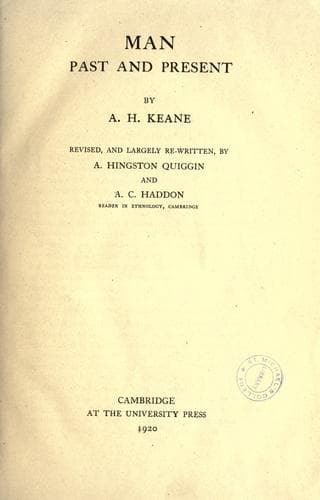
Man, Past and PresentKeane, A. H. (Augustus Henry)
History
Man, Past and Present
Keane, A. H. (Augustus Henry)
Anthropology; Ethnology
America at the close of the Glacial Age. He acknowledged frequent
communication in later times between Asia and America, but maintained
that the movement was rather from America to Asia than otherwise. He was
therefore a strong advocate of the European origin of the American race.
There is no doubt that North America was connected with Asia in Tertiary
times, though some geologists assert that "the far North-west did not
rise from the waves of the Pacific Ocean (which once flowed with a
boundless expanse to the North Pole) until after the glacial period." In
that case "the first inhabitants of America certainly did not get there
in this way, for by that time the bones of many generations were already
bleaching on the soil of the New World[740]." The "Miocene Bridge," as
the land connecting Asia and America in late geological times has been
called, was probably very wide, one side would stretch from Kamchatka to
British Columbia, and the other across Behring Strait. If, as seems
probable, this connection persisted till, or was reconstituted during,
the human period, tribes migrating to America by the more northerly
route would enter the land east of the great barrier of the Rocky
Mountains. The route from the Old World to the New by the Pacific margin
probably remained nearly always open. Thus, while not denying the
possibility of a very early migration from North Europe to North America
through Greenland, it appears more probable that America received its
population from North Asia.
We have next to determine what were the characteristics of the earliest
inhabitants of America, and the approximate date of their arrival. There
have been many sensational accounts of the discoveries of fossil man in
America, which have not been able to stand the criticism of scientific
investigation. It must always be remembered that the evidence is
primarily one of stratigraphy. Assuming, of course, that the human
skeletal remains found in a given deposit are contemporaneous with the
formation of that deposit and not subsequently interred in it, it is for
the geologist to determine the age. The amount of petrifaction and the
state of preservation of the bones are quite fallacious nor can much
reliance be placed upon the anatomical character of the remains.
Primordial human remains may be expected to show ancestral characters to
a marked degree, but as we have insufficient data to enable us to
determine the rate of evolution, anatomical considerations must fit into
the timescale granted by the geologist.
Apart from pure stratigraphy associated animal remains may serve to
support or refute the claims to antiquity, while the presence of
artifacts, objects made or used by man, may afford evidence for
determining the relative date if the cultural stratigraphy of the area
has been sufficiently established.
Public-domain text, read in full here on John Shaqi.
Reviews
Reviews
No reviews yet
Be the first to share your thoughts on this work.
Elsewhere in the archive
Join the Discussion
Join the discussion
Sign in to leave a comment or review.
Sign InorCreate an account