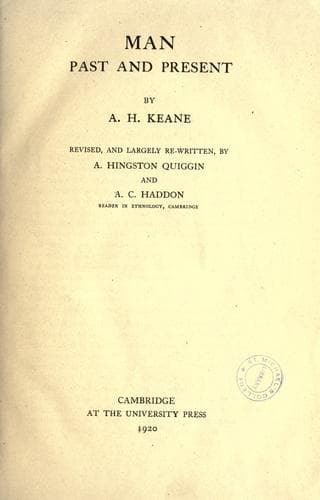
Man, Past and PresentKeane, A. H. (Augustus Henry)
History
Man, Past and Present
Keane, A. H. (Augustus Henry)
Anthropology; Ethnology
It would be difficult to find anywhere a greater contrast than that
which is presented by some of these British Columbian natives, those,
for instance, of Harrison Lake with almost circular heads (88.8), and
some of the Labrador Eskimo with a degree of dolichocephaly not exceeded
even by the Fijian Kai-Colos (65)[757]. But this violent contrast is
somewhat toned by the intermediate forms, such as those of the Tlingits,
the Aleutian islanders, and the western (Alaskan) Eskimo, by which the
transition is effected between the Arctic and the more southern
populations. It is not possible at present to indicate even in outline
the chronology of any of the ethnic movements outlined above. Warren K.
Moorehead[758] agrees with the great majority of American archaeologists
in holding the existence of palaeolithic man in North America as not
proven[759], the so-called palaeoliths being either rejects or rude
tools for rough purposes. When man migrated to America from North and
East Asia whenever that period may have been, he appears to have been in
that stage of culture--or rather of stone technique--which we term
Neolithic, and the drifting movement ceased before he had learnt the use
of metals.
A further proof of the antiquity of the migrations is afforded by
linguistics. A. F. Chamberlain asserts[760] that "it may be said with
certainty, so far as all data hitherto presented are concerned, that no
satisfactory proof whatever has been put forward to induce us to believe
that any single American Indian tongue or group of tongues has been
derived from any Old World form of speech now existing or known to have
existed in the past. In whatever way the multiplicity of American Indian
languages and dialects may have arisen, one can be reasonably sure that
the differentiation and divergence have developed here in America and
are in no sense due to the occasional intrusion of Old World tongues
individually or _en masse_.... Certain real relationships between the
American Indians and the peoples of north-eastern Asia, known as
'Paleo-Asiatics,' have, however, been revealed as a result of the
extensive investigations of the Jesup North Pacific Expedition.... The
general conclusion to be drawn from the evidence is that the so-called
'Paleo-Asiatic' peoples of north-eastern Asia, _i.e._ the Chukchee,
Koryak, Kamchadale, Gilyak, Yukaghir, etc. really belong physically and
culturally with the aborigines of north-western America.... Like the
modern Asiatic Eskimo they represent a reflex from America and Asia, and
not _vice versa_.... It is the opinion of good authorities also that the
'Paleo-Asiatic' peoples belong linguistically with the American Indians
rather than with the other tribes and stocks of northern or southern
Asia. Here we have then the only real relationship of a linguistic
character that has ever been convincingly argued between tongues of the
New World and tongues of the Old."
Public-domain text, read in full here on John Shaqi.
Reviews
Reviews
No reviews yet
Be the first to share your thoughts on this work.
Elsewhere in the archive
Join the Discussion
Join the discussion
Sign in to leave a comment or review.
Sign InorCreate an account