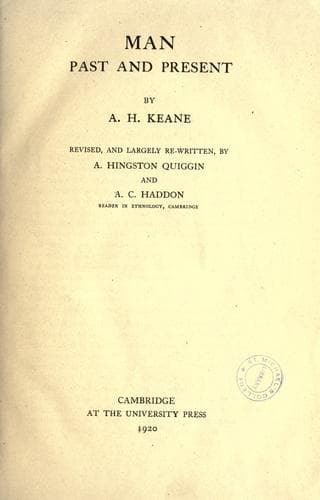
Man, Past and PresentKeane, A. H. (Augustus Henry)
History
Man, Past and Present
Keane, A. H. (Augustus Henry)
Anthropology; Ethnology
It is not merely that the American languages differ from other forms of
speech in their general phonetic, structural and lexical features; they
differ from them in their very morphology, as much, for instance, as in
the zoological world class differs from class, order from order. They
have all of them developed on the same polysynthetic lines, from which
if a few here and there now appear to depart, it is only because in the
course of their further evolution they have, so to say, broken away from
that prototype[761]. Take the rudest or the most highly cultivated
anywhere from Alaska to Fuegia--Eskimauan, Iroquoian, Algonquian, Aztec,
Tarascan, Ipurina, Peruvian, Yahgan--and you will find each and all
giving abundant evidence of this universal polysynthetic character, not
one true instance of which can be found anywhere in the eastern
hemisphere. There is incorporation with the verb, as in Basque, many of
the Caucasus tongues, and the Ural-Altaic group; but it is everywhere
limited to pronominal and purely relational elements.
But in the American order of speech there is no such limitation, and not
merely the pronouns, which are restricted in number, but the nouns with
their attributes, which are practically numberless, all enter
necessarily into the verbal paradigm. Thus in Tarascan (Mexico):
_hopocuni_ = to wash the hands; _hopodini_ = to wash the ears, from
_hoponi_ = to wash, which cannot be used alone[762]. So in Ipurina
(Amazonia): _nicucacatcaurumatinii_ = I draw the cord tight round your
waist, from _ni_, I; _cucaca_, to draw tight; _tca_, cord; _turuma_,
waist; _tini_, characteristic verbal affix; _i_, thy, referring to
waist[763].
We see from such examples that polysynthesis is not a primitive
condition of speech, as is often asserted, but on the contrary a
highly developed system, in which the original agglutinative process
has gone so far as to attract all the elements of the sentence to
the verb, round which they cluster like swarming bees round their
queen. In Eskimauan the tendency is shown in the construction of
nouns and verbs, by which other classes of words are made almost
unnecessary, and one word, sometimes of interminable length, is
able to express a whole sentence with its subordinate clauses. H. Rink,
one of the first Eskimo scholars of modern times, gives the instance:
"Suerukame-autdlasassoq-tusaramiuk-tuningingmago-iluarin-gilat = they
did not approve that he (_a_) had omitted to give him (_b_) something,
as he (_a_) heard that he (_b_) was going to depart on account of being
destitute of everything[764]." Such monstrosities "are so complicated
that in daily speech they could hardly ever occur; but still they are
correct and can be understood by intelligent people[765]."
Public-domain text, read in full here on John Shaqi.
Reviews
Reviews
No reviews yet
Be the first to share your thoughts on this work.
Elsewhere in the archive
Join the Discussion
Join the discussion
Sign in to leave a comment or review.
Sign InorCreate an account