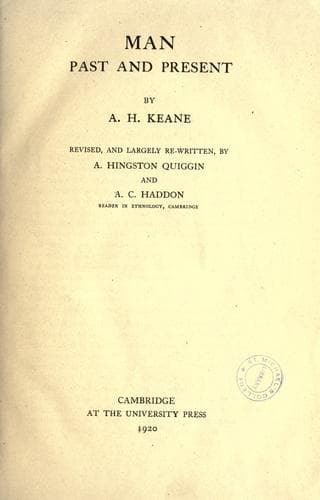
Man, Past and PresentKeane, A. H. (Augustus Henry)
History
Man, Past and Present
Keane, A. H. (Augustus Henry)
Anthropology; Ethnology
He gives another and much longer example, which the reader may be
spared, adding that there are altogether about 200 particles, as many as
ten of which may be piled up on any given stem. The process also often
involves great phonetic changes, by which the original form of the
elements becomes disguised, as, for instance, in the English _hap'oth_ =
half-penny-worth. The attempt to determine the number of words that
might be formed in this way on a single stem, such as _igdlo_, a house,
had to be given up after getting as far as the compound
_igdlorssualiortugssarsiumavoq_ = he wants to find one who will build a
large house.
It is clear that such a linguistic evolution implies both the postulated
isolation from other influences, which must have disturbed and broken up
the cumbrous process, and also the postulated long period of time to
develop and consolidate the system throughout the New World. But time is
still more imperiously demanded by the vast number of stock languages,
many already extinct, many still current all over the continent, all of
which differ profoundly in their vocabulary, often also in their
phonesis, and in fact have nothing in common except this extraordinary
polysynthetic groove in which they are cast. There are probably about 75
stock languages in North America, of which 58 occur north of Mexico.
But even that conveys but a faint idea of the astonishing diversity of
speech prevailing in this truly linguistic Babel. J. W. Powell[766]
points out that the practically distinct idioms are far more numerous
than might be inferred even from such a large number of mother tongues.
Thus, in the Algonquian[767] linguistic family he tells us there are
about 40, no one of which could be understood by a people speaking
another; in Athapascan from 30 to 40; in Siouan over 20; and in
Shoshonian a still greater number[768]. The greatest linguistic
diversity in a relatively small area is found in the state of
California, where, according to Powell's classification, 22 distinct
stocks of languages are spoken. R. B. Dixon and A. L. Kroeber[769] show
however that these fall into three morphological groups which are also
characterised by certain cultural features. It is the same, or perhaps
even worse, in Central and in South America, where the linguistic
confusion is so great that no complete classification of the native
tongues seems possible. Clements R. Markham in the third edition of his
exhaustive list of the Amazonian tribes[770] has no less than 1087
entries. He concludes that these may be referred to 485 distinct tribes
in all the periods, since the days of Acuna (1639). Deducting some 111
as extinct or nearly so, the total amounts to "323 at the outside" (p.
135). But for such linguistic differences, large numbers of these groups
would be quite indistinguishable from each other, so great is the
prevailing similarity in physical appearance and usages in many
districts. Thus Ehrenreich tells us that, "despite their
Public-domain text, read in full here on John Shaqi.
Reviews
Reviews
No reviews yet
Be the first to share your thoughts on this work.
Elsewhere in the archive
Join the Discussion
Join the discussion
Sign in to leave a comment or review.
Sign InorCreate an account