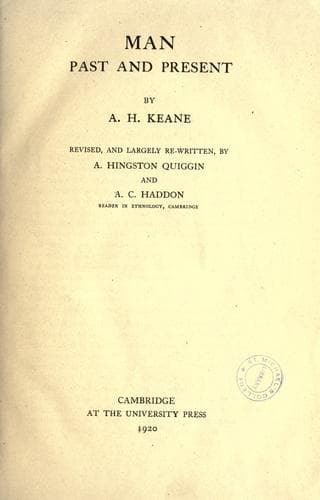
Man, Past and PresentKeane, A. H. (Augustus Henry)
History
Man, Past and Present
Keane, A. H. (Augustus Henry)
Anthropology; Ethnology
There are three forms of social grouping: the Family, House-mates, and
Place-mates. (1) The family consists of a man, his wife or wives, their
children and adopted children; widows and their children may be adopted,
but the woman retains her own fireplace. Sometimes men are adopted, such
as bachelors without any relatives, cripples, or impoverished men. Joint
ownership and use of a boat and house, and common labour and toil in
obtaining the means of support define the real community of the family.
(2) House-mates are families that join together to build and occupy and
maintain the same house. This form of establishment is especially common
in Greenland, but each family keeps its separate establishment inside
the common house. (3) Place-fellows. The inhabitants of the same hamlet
or winter establishment form one community although no chief is elected
or authority acknowledged.
Generally children are betrothed when very young. The newly married pair
usually live at first with the wife's family. Both polygyny and
polyandry occur. A man may lend or exchange his wife for a whole season
or longer, as a sign of friendship. On certain occasions it is even
commanded by religious law. There is no government, but there is a kind
of chief in the settlement, though his authority is very limited. He is
called the "pimain," _i.e._ he who knows everything best. He decides the
proper time to shift the huts from one place to another, he may ask some
men to go sealing, others to go deer hunting, but there is not the
slightest obligation to obey him. The men in a community may form
themselves into an informal council for the regulation of affairs. The
decorative art of the Eskimo is not remarkably developed, but the
pictorial art consists of clever sketches of everyday scenes and there
is a well developed plastic art. Many of the carvings are toys and are
made for the pleasure of the work. "The religious views and practices of
the Eskimo while, on the whole, alike in their fundamental traits, show
a considerable amount of differentiation in the extreme east and in the
extreme west. It would seem that the characteristic traits of shamanism
are common to all the Eskimo tribes. The art of the shaman (angakok) is
acquired by the acquisition of guardian spirits.... Besides the spirits
which may become guardian spirits of men, the Eskimo believes in a great
many others which are hostile and bring disaster and death.... The
ritualistic development of Eskimo religion is very slight[814]."
Public-domain text, read in full here on John Shaqi.
Reviews
Reviews
No reviews yet
Be the first to share your thoughts on this work.
Elsewhere in the archive
Join the Discussion
Join the discussion
Sign in to leave a comment or review.
Sign InorCreate an account