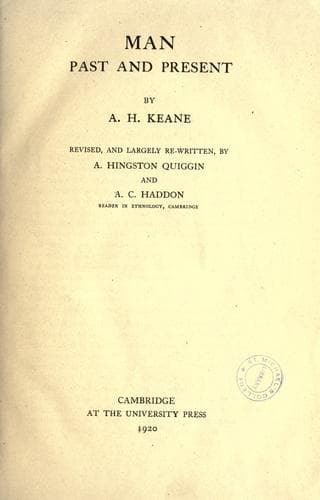
Man, Past and PresentKeane, A. H. (Augustus Henry)
History
Man, Past and Present
Keane, A. H. (Augustus Henry)
Anthropology; Ethnology
II. Mackenzie Area. Skirting the Eskimo area is a belt of semi-Arctic
lands almost cut in two by Hudson Bay. To the west are the Dene tribes,
who are believed to fall into three culture groups, an eastern group,
Yellow Knives, Dog Rib, Hares, Slavey, Chipewyan and Beaver; a
south-western group, Nahane, Sekani, Babine and Carrier; and a
north-western group, comprising the Kutchin, Loucheux, Ahtena and
Khotana. The material culture of the south-western group is deduced
from the writings of Father Morice[815]. All the tribes are hunters of
large or small game, caribou are often driven into enclosures, small
game taken in snares or traps; various kinds of fish are largely used,
and a few of the tribes on the head waters of the Pacific take salmon;
large use of berries is made, they are mashed and dried by a special
process; edible roots and other vegetable foods are used to some extent;
utensils are of wood and bark; there is no pottery; bark vessels are
used for boiling with or without stones; travel in summer is largely by
canoe, in winter by snowshoe; dog sleds are used to some extent, but
chiefly since trade days, the toboggan form prevailing; clothing is of
skins; mittens and caps are worn; there is no weaving except rabbit-skin
garments, but fine network occurs on snowshoes, bags, and fish nets,
materials being of bark fibre, sinew and babiche; there is also a
special form of woven quill work; the typical habitation seems to be the
double lean-to, though many intrusive forms occur; other material
culture traits include the making of fish-hooks and spears; a limited
use of copper; and poorly developed work in stone.
The physical characteristics vary very much from tribe to tribe. The
Sekani, according to Morice, are slender and bony, in stature rather
below the average, with a narrow forehead, hollow cheeks, prominent
cheekbones, small eyes deeply sunk in their orbit, the upper lip very
thin and the lower somewhat protruding, the chin very small and the nose
straight. The Carriers, on the contrary, are tall and stout, without as
a rule being too corpulent. The men average 1.66 m. in height. Their
forehead is much broader than that of the Sekani, and less receding than
is usual with American aborigines. The face is full, and the nose
aquiline. All the tribes are remarkably unwarlike, timid, and even
cowardly. Weapons are seldom used and in personal combat, which consists
in a species of wrestling, knives are previously laid aside. The fear of
enemies is a marked feature, due in part, doubtless, to traditional
recollection of the raids of earlier days. Their honesty is noted by all
travellers. Morice records that among the Sekani a trader will sometimes
go on a trapping expedition, leaving his store unlocked, without fear
of any of its contents going amiss. Meantime a native may call in his
absence, help himself to as much powder and shot or any other item as he
may need, but he will never fail to leave there an exact equivalent in
furs.
Public-domain text, read in full here on John Shaqi.
Reviews
Reviews
No reviews yet
Be the first to share your thoughts on this work.
Elsewhere in the archive
Join the Discussion
Join the discussion
Sign in to leave a comment or review.
Sign InorCreate an account