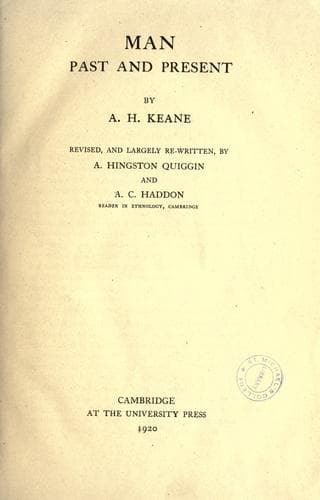
Man, Past and PresentKeane, A. H. (Augustus Henry)
History
Man, Past and Present
Keane, A. H. (Augustus Henry)
Anthropology; Ethnology
Another phase of religious belief in Upper Guinea is ancestry worship,
which has here been developed to a degree unknown elsewhere. As the
departed have to be maintained in the same social position beyond the
grave that they enjoyed in this world, they must be supplied with
slaves, wives, and attendants, each according to his rank. Hence the
institution of the so-called "customs," or anniversary feasts of the
dead, accompanied by the sacrifice of human victims, regulated at first
by the status and afterwards by the whim and caprice of chiefs and
kings. In the capitals of the more powerful states, Ashanti, Dahomey,
Benin, the scenes witnessed at these sanguinary rites rivalled in horror
those held in honour of the Aztec gods. Details may here be dispensed
with on a repulsive subject, ample accounts of which are accessible from
many sources to the general reader. In any case these atrocities teach
no lesson, except that most religions have waded through blood to better
things, unless arrested in mid-stream by the intervention of higher
powers, as happily in Upper Guinea, where the human shambles of Kumassi,
Abomeh, Benin and most other places have now been swept away.
On the capture of Benin by the English in 1897 a rare and unexpected
prize fell into the hands of ethnologists. Here was found a large
assortment of carved ivories, woodwork, and especially a series of about
300 bronze and brass plates or panels with figures of natives and
Europeans, armed and in armour, in full relief, all cast by the _cire
perdue_ process[166], some barbaric, others, and especially a head in
the round of a young negress, showing high artistic skill. Many of these
remarkable objects are in the British Museum, where they have been
studied by C. H. Read and O. M. Dalton[167], who are evidently right in
assigning the better class to the sixteenth century, and to the aid, if
not the hand, of some Portuguese artificers in the service of the King
of Benin. They add that "casting of an inferior kind continues down to
the present time," and it may here be mentioned that armour has long
been and is still worn by the cavalry, and even their horses, in the
Muhammadan states of Central Sudan. "The chiefs (_Kashellawa_) who serve
as officers under the Sultan [of Bornu] and act as his bodyguard wear
jackets of chain armour and cuirasses of coats of mail[168]." It is
clear that metal casting in a large way has long been practised by the
semi-civilised peoples of Sudan.
Public-domain text, read in full here on John Shaqi.
Reviews
Reviews
No reviews yet
Be the first to share your thoughts on this work.
Join the Discussion
Join the discussion
Sign in to leave a comment or review.
Sign InorCreate an account