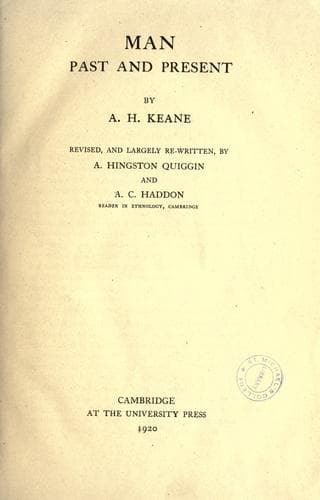
Man, Past and PresentKeane, A. H. (Augustus Henry)
History
Man, Past and Present
Keane, A. H. (Augustus Henry)
Anthropology; Ethnology
A curious result of these relations is that in the wooded districts some
of the natives have reverted to arboreal habits, taking refuge during
the raids in the branches of huge bombax-trees converted into temporary
strongholds. Round the vertical stem of these forest giants is erected a
breast-high look-out, while the higher horizontal branches, less exposed
to the fire of the enemy, support strongly-built huts and store-houses,
where the families of the fugitives take refuge with their effects,
including, as Nachtigal assures us[192], their domestic animals, such as
goats, dogs, and poultry. During the siege of the aerial fortress, which
is often successfully defended, long light ladders of withies are let
down at night, when no attack need be feared, and the supply of water
and provisions is thus renewed from _caches_ or hiding-places round
about. In 1872 Nachtigal accompanied a predatory excursion to the pagan
districts south of Baghirmi, when an attack was made on one of these
tree-fortresses. Such citadels can be stormed only at a heavy loss, and
as the Gaberi (Baghirmi) warriors had no tools capable of felling the
great bombax-tree, they were fain to rest satisfied with picking off a
poor wretch now and then, and barbarously mutilating the bodies as they
fell from the overhanging branches.
Some of these aborigines disfigure their faces by the disk-like
lip-ornament, which is also fashionable in Nyassaland, and even amongst
the South American Botocudos. The type often differs greatly, and while
some of the widespread Mosgu tribes are of a dirty black hue, with
disagreeable expression, wide open nostrils, thick lips, high
cheek-bones, coarse bushy hair, and disproportionate knock-kneed legs,
other members of the same family astonished Barth "by the beauty and
symmetry of their forms, and by the regularity of their features, which
in some had nothing of what is called the Negro type. But I was still
more astonished at their complexion, which was very different in
different individuals, being in some of a glossy black, and in others of
a light copper, or rather rhubarb colour, the intermediate shades being
almost entirely wanting. I observed in one house a really beautiful
female who, with her son, about eight or nine years of age, formed a
most charming group, well worthy of the hand of an accomplished artist.
The boy's form did not yield in any respect to the beautiful symmetry of
the most celebrated Grecian statues. His hair, indeed, was very short
and curled, but not woolly. He, as well as his mother and the whole
family, were of a pale or yellowish-red complexion, like rhubarb[193]."
Public-domain text, read in full here on John Shaqi.
Reviews
Reviews
No reviews yet
Be the first to share your thoughts on this work.
Join the Discussion
Join the discussion
Sign in to leave a comment or review.
Sign InorCreate an account