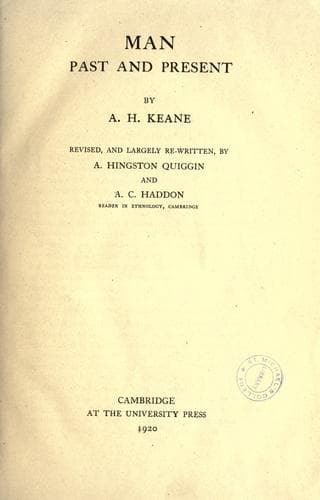
Man, Past and PresentKeane, A. H. (Augustus Henry)
History
Man, Past and Present
Keane, A. H. (Augustus Henry)
Anthropology; Ethnology
reference on Egyptian monuments to Negroes in Nubia when, as proved by
excavations, the inhabitants were by no means Negroes or even frankly
Negroid. Seligman's solution of the difficulty is as follows (p. 619).
It seems that only one explanation is tenable, namely that for a period
subsequent to the Middle Kingdom the country in the neighbourhood of the
Second Cataract became essentially a Negro country and may have remained
in this condition for some little time. Then a movement in the opposite
direction set in; the Negroes, diminished by war, were in part driven
back by the great conquerors of the New Empire; those that were left
mixed with the Egyptian garrisons and traders and once more a hybrid
race arose which, however, preserved the language of its Negro
ancestors. Although Seligman regards the conclusion that this race gave
rise directly to the present-day inhabitants of Nubia as "premature,"
and suggests further mixture with the Beja of the eastern deserts,
Elliot Smith recognises the essential similarity between the homogeneous
blend of Egyptian and Negro traits which characterise the Middle Nubian
people (contemporary with the Middle Empire, XII-XVII dynasties), a type
which "seems to have remained dominant in Nubia ever since then, for the
span of almost 4000 years[211]."
Before the incursions of the Nubian-Arab traders and raiders, who began
to form settlements (_zeribas_, fenced stations) in the Upper Nile
regions above Khartum about the middle of the nineteenth century, most
of the Nile-Congo divide (White Nile tributaries and Welle-Makua basin)
belonged in the strictest sense to the Negro domain. Sudanese tribes,
and even great nations reckoned by millions, had been for ages in almost
undisturbed possession, not only of the main stream from the equatorial
lakes to and beyond the Sobat junction, but also of the Sobat Valley
itself, and of the numerous south-western head-waters of the White Nile
converging about Lake No above the Sobat junction. Nearly all the Nile
peoples--the _Shilluks_ and _Dinkas_ about the Sobat confluence, the
_Bari_ and _Nuers_ of the Bahr-el-Jebel, the _Bongos_ (_Dors_), _Rols_,
_Golos_, _Mittus_, _Madis_, _Makarakas_, _Abakas_, _Mundus_, and many
others about the western affluents, as well as the _Funj_ of Senaar--had
been brought under the Khedivial rule before the revolt of the Mahdi.
The same fate had already overtaken or was threatening the formerly
powerful _Mombuttu_ (_Mangbattu_) and _Zandeh_[212] nations of the Welle
lands, as well as the _Krej_ and others about the low watersheds of the
Nile-Congo and Chad basins. Since then the Welle groups have been
subjected to the jurisdiction of the Congo Free State, while the
political destinies of the Nilotic tribes must henceforth be controlled
by the British masters of the Nile lands from the Great Lakes to the
Mediterranean.
Public-domain text, read in full here on John Shaqi.
Reviews
Reviews
No reviews yet
Be the first to share your thoughts on this work.
Join the Discussion
Join the discussion
Sign in to leave a comment or review.
Sign InorCreate an account