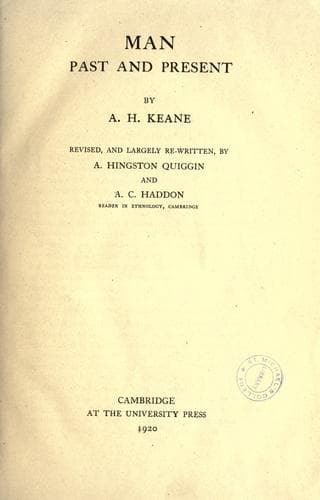
Man, Past and PresentKeane, A. H. (Augustus Henry)
History
Man, Past and Present
Keane, A. H. (Augustus Henry)
Anthropology; Ethnology
It cannot be said that any clear view of pleistocene man can be obtained
from these imperfect scraps of evidence, valuable though they are.
Rather may we agree with Keith that the problem grows more instead of
less complex. "In our first youthful burst of Darwinianism we pictured
our evolution as a simple procession of forms leading from ape to man.
Each age, as it passed, transformed the men of the time one stage nearer
to us--one more distant from the ape. The true picture is very
different. We have to conceive an ancient world in which the family of
mankind was broken up into narrow groups or genera, each genus again
divided into a number of species--much as we see in the monkey or ape
world of to-day. Then out of that great welter of forms one species
became the dominant form, and ultimately the sole surviving one--the
species represented by the modern races of mankind[18]."
We may assume therefore that the earth was mainly peopled by the
generalised pleistocene precursors, who moved about, like the other
migrating faunas, unconsciously, everywhere following the lines of least
resistance, advancing or receding, and acting generally on blind impulse
rather than of any set purpose.
That such must have been the nature of the first migratory movements
will appear evident when we consider that they were carried on by rude
hordes, all very much alike, and differing not greatly from other
zoological groups, and further that these migrations took place prior to
the development of all cultural appliances beyond the ability to wield a
broken branch or a sapling, or else chip or flake primitive stone
implements[19].
Herein lies the explanation of the curious phenomenon, which was a
stumbling-block to premature systematists, that all the works of early
man everywhere present the most startling resemblances, affording
absolutely no elements for classification, for instance, during the
times corresponding with the Chellean or first period of the Old Stone
Age. The implements of palaeolithic type so common in parts of South
India, South Africa, the Sudan, Egypt, etc., present a remarkable
resemblance to one another. This, while affording a _prima facies_ case
for, is not conclusive of, the migrations of a definite type of
humanity.
Public-domain text, read in full here on John Shaqi.
Reviews
Reviews
No reviews yet
Be the first to share your thoughts on this work.
Join the Discussion
Join the discussion
Sign in to leave a comment or review.
Sign InorCreate an account