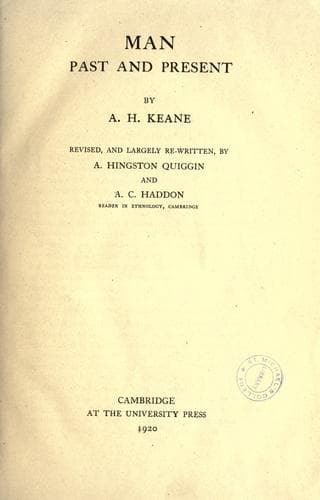
Man, Past and PresentKeane, A. H. (Augustus Henry)
History
Man, Past and Present
Keane, A. H. (Augustus Henry)
Anthropology; Ethnology
To the admixture of the Hamitic and Negro elements amongst the
Lacustrians may perhaps be attributed the curious blend of primitive and
higher institutions in these communities. At the head of the State was a
Kabaka, king or emperor, although the title was also borne by the
queen-mother and the queen-sister. This autocrat had his _Lukiko_, or
Council, of which the members were the _Katikiro_, Prime Minister and
Chief Justice, the _Kimbugwe_, who had charge of the King's umbilical
cord, and held rank next to the _Katikiro_, and ten District chiefs, for
the administration of the ten large districts into which the country was
divided, each rendering accounts to the _Katikiro_ and through him to
the King. Each District chief had to maintain in good order a road some
four yards wide, reaching from the capital to his country seat, a
distance possibly of nearly 100 miles. Each District chief had
sub-chiefs under him, independent of the chief in managing their own
portion of land. These were responsible for keeping in repair the road
between their own residence and that of the District chief. In each
district was a supreme court, and every sub-chief, even with only a
dozen followers, could hold a court and try cases among his own people.
The people, however, could take their cases from one court to another
until eventually they came before the _Katikiro_ or the King.
Yet together with this highly advanced social and political development
a totemic exogamous clan system was in force throughout Uganda, all the
Ba-Ganda belonging to one of 29 _kika_ or clans, each possessing two
totems held sacred by the clan. Thus the Lion (_Mpologoma_) clan had the
Eagle (_Mpungu_) for its second totem; the Mushroom (_Butiko_) clan had
the Snail (_Nsonko_); the Buffalo (_Mbogo_) clan had a New Cooking Pot
(_Ntamu_). Each clan had its chief, or Father, who resided on the clan
estate which was also the clan burial-ground, and was responsible for
the conduct of the members of his branch. All the clans were
exogamous[242], and a man was expected to take a second wife from the
clan of his paternal grandmother[243].
No direct relations appear to exist between the Lacustrians and the
_Wa-Kikuyu_, _Wa-Kamba_, _Wa-Pokomo_, Wa-Gweno, _Wa-Chaga_, _Wa-Teita_,
_Wa-Taveita_, and others[244], who occupy the region east of Victoria
Nyanza, between the Tana, north-east frontier of Bantuland, and the
southern slopes of Kilimanjaro. Their affinities seem to be rather with
the _Wa-Nyika_, _Wa-Boni_, _Wa-Duruma_, _Wa-Giryama_, and the other
coast tribes between the Tana and Mombasa. All of these tribes have more
or less adopted the habits and customs of the Masai.
Public-domain text, read in full here on John Shaqi.
Reviews
Reviews
No reviews yet
Be the first to share your thoughts on this work.
Elsewhere in the archive
Join the Discussion
Join the discussion
Sign in to leave a comment or review.
Sign InorCreate an account