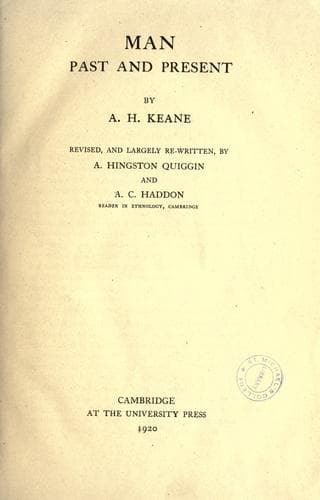
Man, Past and PresentKeane, A. H. (Augustus Henry)
History
Man, Past and Present
Keane, A. H. (Augustus Henry)
Anthropology; Ethnology
At last came King Ma'anda, who pretended to be a great hunter, but it
was only to roam the woodlands in search of Kintu, and thus have tidings
of him. One day a peasant, obeying the directions of a thrice-dreamt
dream, came to a place in the forest, where was an aged man on a throne
between two rows of armed warriors, seated on mats, his long beard white
with age, and all his men fair as white people and clothed in white
robes. Then Kintu, for it was he, bid the peasant hasten to summon
Ma'anda thither, but only with his mother and the messenger. At the
Court Ma'anda recognised the stranger whom he had that very night seen
in a dream, and so believed his words and at once set out with his
mother and the peasant. But the Katikiro, or Prime Minister, through
whom the message had been delivered to the king, fearing treachery, also
started on their track, keeping them just in view till the
trysting-place was reached. But Kintu, who knew everything, saw him all
the time, and when he came forward on finding himself discovered the
enraged Ma'anda pierced his faithful minister to the heart and he fell
dead with a shriek. Thereupon Kintu and his seated warriors instantly
vanished, and the king with the others wept and cried upon Kintu till
the deep woods echoed Kintu, Kintu-u, Kintu-u-u. But the blood-hating
Kintu was gone, and to this day has never again been seen or heard of by
any man in Buganda. The references to the north and to Kintu and his
ghostly warriors "fair as white people" need no comment[240]. It is
noteworthy that in some of the Nyassaland dialects _Kintu_ (_Caintu_)
alternates with _Mulungu_ as the name of the Supreme Being, the great
ancestor of the tribe[241].
Then follows more traditional or legendary matter, including an account
of the wars with the fierce Wakedi, who wore iron armour, until
authentic history is reached with the atrocious Suna II (1836-60),
father of the scarcely less atrocious M'tesa. After his death in 1884
Buganda and the neighbouring states passed rapidly through a series of
astonishing political, religious, and social vicissitudes, resulting in
the present _pax Britannica_, and the conversion of large numbers, some
to Islam, others to one form or another of Christianity. At times it
might have been difficult to see much religion in the ferocity of the
contending factions; but since the establishment of harmony by the
secular arm, real progress has been made, and the Ba-Ganda especially
have displayed a remarkable capacity as well as eagerness to acquire a
knowledge of letters and of religious principles, both in the Protestant
and the Roman Catholic communities. Printing-presses, busily worked by
native hands, are needed to meet the steadily increasing demand for a
vernacular literature, in a region where blood had flowed continually
from the disappearance of "Kintu" till the British occupation.
Public-domain text, read in full here on John Shaqi.
Reviews
Reviews
No reviews yet
Be the first to share your thoughts on this work.
Elsewhere in the archive
Join the Discussion
Join the discussion
Sign in to leave a comment or review.
Sign InorCreate an account