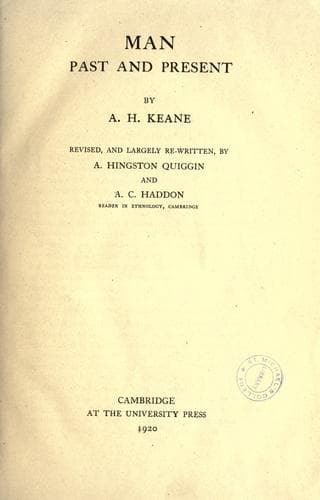
Man, Past and PresentKeane, A. H. (Augustus Henry)
History
Man, Past and Present
Keane, A. H. (Augustus Henry)
Anthropology; Ethnology
But the chief interest presented by the Wa-Giryama is centred in their
religious ideas, which are mainly connected with ancestry-worship, and
afford an unexpected insight into the origin and nature of that perhaps
most primitive of all forms of belief. There is, of course, a vague
entity called a "Supreme Being" in ethnographic writings, who, like the
Algonquian Manitu, crops up under various names (here _Mulungu_) all
over east Bantuland, but on analysis generally resolves itself into some
dim notion growing out of ancestry-worship, a great or aged person,
eponymous hero or the like, later deified in diverse ways as the
Preserver, the Disposer, and especially the Creator. These Wa-Giryama
suppose that from his union with the Earth all things have sprung, and
that human beings are Mulungu's hens and chickens. But there is also an
idea that he may be the manes of their fathers, and thus everything
becomes merged in a kind of apotheosis of the departed. They think "the
disembodied spirit is powerful for good and evil. Individuals worship
the shades of their immediate ancestors or elder relatives; and the
_k'omas_ [souls?] of the whole nation are worshipped on public
occasions."
Although the European ghost or "revenant" is unknown, the spirits of
near ancestors may appear in dreams, and express their wishes to the
living. They ask for sacrifices at their graves to appease their hunger,
and such sacrifices are often made with a little flour and water poured
into a coconut shell let into the ground, the fowls and other victims
being so killed that the blood shall trickle into the grave. At the
offering the dead are called on by name to come and partake, and bring
their friends with them, who are also mentioned by name. But whereas
Christians pray to be remembered of heaven and the saints, the
Wa-Giryama pray rather that the new-born babe be forgotten of Mulungu,
and so live. "Well!" they will say on the news of a birth, "may Mulungu
forget him that he may become strong and well." This is an instructive
trait, a reminiscence of the time when Mulungu, now almost harmless or
indifferent to mundane things, was the embodiment of all evil, hence to
be feared and appeased in accordance with the old dictum _Timor fecit
deos_.
Public-domain text, read in full here on John Shaqi.
Reviews
Reviews
No reviews yet
Be the first to share your thoughts on this work.
Elsewhere in the archive
Join the Discussion
Join the discussion
Sign in to leave a comment or review.
Sign InorCreate an account