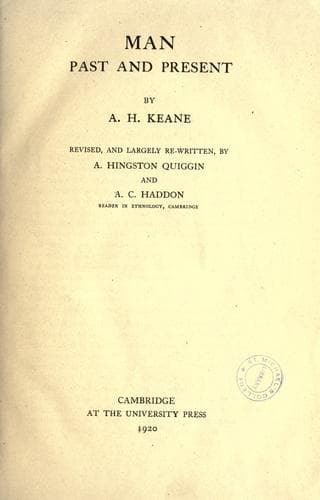
Man, Past and PresentKeane, A. H. (Augustus Henry)
History
Man, Past and Present
Keane, A. H. (Augustus Henry)
Anthropology; Ethnology
At present no distinction is drawn between good and bad spirits, but all
are looked upon as, of course, often, though not always, more powerful
than the living, but still human beings subject to the same feelings,
passions, and fancies as they are. Some are even poor weaklings on whom
offerings are wasted. "The Shade of So-and-so's father is of no use at
all; it has finished up his property, and yet he is no better," was a
native's comment on the result of a series of sacrifices a man had
vainly made to his father's shade to regain his health. They may also be
duped and tricked, and when _pombe_ (beer) is a-brewing, some is poured
out on the graves of the dead, with the prayer that they may drink, and
when drunk fall asleep, and so not disturb the living with their brawls
and bickerings, just like the wrangling fairies in _A Midsummer Night's
Dream_[250].
Far removed from such crass anthropomorphism, but not morally much
improved, are the kindred Wa-Swahili, who by long contact and
interminglings have become largely Arabised in dress, religion, and
general culture. They are graphically described by Taylor as "a
seafaring, barter-loving race of slave-holders and slave-traders, strewn
in a thin line along a thousand miles of creeks and islands; inhabitants
of a coast that has witnessed incessant political changes, and a
succession of monarchical dynasties in various centres; receiving into
their midst for ages past a continuous stream of strange blood,
consisting not only of serviles from the interior, but of immigrants
from Persia, Arabia, and Western India; men that have come to live, and
often to die, as resident aliens, leaving in many cases a hybrid
progeny. Of one section of these immigrants--the Arabs--the religion has
become the master-religion of the land, overspreading, if not entirely
supplanting, the old Bantu ancestor-worship, and profoundly affecting
the whole family life."
The Wa-Swahili are in a sense a historical people, for they formed the
chief constituent elements of the renowned Zang (Zeng) empire[251],
which in Edrisi's time (twelfth century) stretched along the seaboard
from Somaliland to and beyond the Zambesi. When the Portuguese burst
suddenly into the Indian Ocean it was a great and powerful state,
or rather a vast confederacy of states, with many flourishing
cities--Magdoshu, Brava, Mombasa, Melindi, Kilwa, Angosha, Sofala--and
widespread commercial relations extending across the eastern waters
to India and China, and up the Red Sea to Europe. How these great
centres of trade and eastern culture were one after the other
ruthlessly destroyed by the Portuguese corsairs _co' o ferro e fogo_
("with sword and fire," Camoens) is told by Duarte Barbosa, who was
himself a Portuguese and an eyewitness of the havoc and the horrors
that not infrequently followed in the trail of his barbarous
fellow-countrymen[252].
Public-domain text, read in full here on John Shaqi.
Reviews
Reviews
No reviews yet
Be the first to share your thoughts on this work.
Elsewhere in the archive
Join the Discussion
Join the discussion
Sign in to leave a comment or review.
Sign InorCreate an account