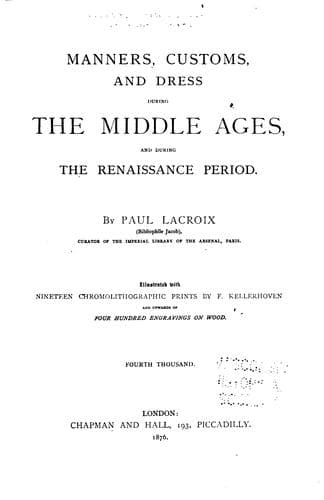
Manners, Customs, and Dress During the Middle Ages and During the Renaissance PeriodJacob, P. L.
History
Manners, Customs, and Dress During the Middle Ages and During the Renaissance Period
Jacob, P. L.
Clothing and dress; Manners and customs; Middle Ages; Renaissance
We have had to treat elsewhere of the rules and regulations of the repasts
under the Merovingian and Carlovingian kings. We have also spoken of the
table service of the thirteenth century (see chapter on "Private Life").
The earliest author who has left us any documents on this curious subject
is that excellent bourgeois to whom we owe the "Ménagier de Paris." He
describes, for instance, in its fullest details, a repast which was given
in the fourteenth century by the Abbé de Lagny, to the Bishop of Paris,
the President of the Parliament, the King's attorney and advocate, and
other members of his council, in all sixteen guests. We find from this
account that "my lord of Paris, occupying the place of honour, was, in
consequence of his rank, served on covered dishes by three of his squires,
as was the custom for the King, the royal princes, the dukes, and peers;
that Master President, who was seated by the side of the bishop, was also
served by one of his own servants, but on uncovered dishes, and the other
guests were seated at table according to the order indicated by their
titles or charges."
The bill of fare of this feast, which was given on a fast-day, is the more
worthy of attention, in that it proves to us what numerous resources
cookery already possessed. This was especially the case as regards fish,
notwithstanding that the transport of fresh sea-fish was so difficult,
owing to the bad state of the roads.
First, a quarter of a pint of Grenache was given to each guest on sitting
down, then "hot _eschaudés_, roast apples with white sugar-plums upon
them, roasted figs, sorrel and watercress, and rosemary."
"Soups.--A rich soup, composed of six trout, six tenches, white herring,
freshwater eels, salted twenty-four hours, and three whiting, soaked
twelve hours; almonds, ginger, saffron, cinnamon powder and sweetmeats.
"Salt-Water Fish.--Soles, gurnets, congers, turbots, and salmon.
"Fresh-Water Fish.--_Lux faudis_ (pike with roe), carps from the Marne,
breams.
"Side-Dishes.--Lampreys _à la boee_, orange-apples (one for each guest),
porpoise with sauce, mackerel, soles, bream, and shad _à la cameline_,
with verjuice, rice and fried almonds upon them; sugar and apples.
[Illustration: Fig. 125.--Officers of the Table and of the Chamber of the
Imperial Court: Cup-bearer, Cook, Barber, and Tailor, from a Picture in
the "Triomphe de Maximilien T.," engraved by J. Resch, Burgmayer, and
others (1512), from Drawings by Albert Durer.]
"Dessert.--Stewed fruit with white and vermilion sugar-plums; figs, dates,
grapes, and filberts.
"Hypocras for _issue de table_, with _oublies_ and _supplications_.
"Wines and spices compose the _baute-hors_."
To this fasting repast we give by way of contrast the bill of fare at the
nuptial feast of Master Helye, "to which forty guests were bidden on a
Tuesday in May, a 'day of flesh.'"
"Soups.--Capons with white sauce, ornamented with pomegranate and crimson
sweetmeats.
Public-domain text, read in full here on John Shaqi.
Reviews
Reviews
No reviews yet
Be the first to share your thoughts on this work.
Elsewhere in the archive
Join the Discussion
Join the discussion
Sign in to leave a comment or review.
Sign InorCreate an account