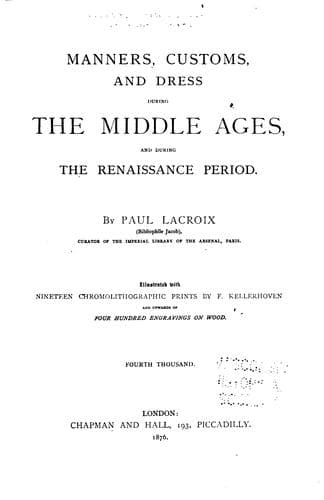
Manners, Customs, and Dress During the Middle Ages and During the Renaissance PeriodJacob, P. L.
History
Manners, Customs, and Dress During the Middle Ages and During the Renaissance Period
Jacob, P. L.
Clothing and dress; Manners and customs; Middle Ages; Renaissance
"Roasts.--Quarter of roe-deer, goslings, young chickens, and sauces of
orange, cameline, and verjuice.
"Side-Dishes.--Jellies of crayfish and loach; young rabbits and pork.
"Dessert.--_Froumentée_ and venison.
"Issue.--Hypocras.
"Boute-Hors.--Wine and spices."
The clever editor of the "Ménagier de Paris," M. le Baron Jerôme Pichon,
after giving us this curious account of the mode of living of the citizens
of that day, thus sums up the whole arrangements for the table in the
fourteenth century: "The different provisions necessary for food are
usually entrusted to the squires of the kitchen, and were chosen,
purchased, and paid for by one or more of these officials, assisted by the
cooks. The dishes prepared by the cooks were placed, by the help of the
esquires, on dressers in the kitchen until the moment of serving. Thence
they were carried to the tables. Let us imagine a vast hall hung with
tapestries and other brilliant stuffs. The tables are covered with fringed
table-cloths, and strewn with odoriferous herbs; one of them, called the
Great Table, is reserved for the persons of distinction. The guests are
taken to their seats by two butlers, who bring them water to wash. The
Great Table is laid out by a butler, with silver salt-cellars (Figs. 126
and 127), golden goblets with lids for the high personages, spoons and
silver drinking cups. The guests eat at least certain dishes on
_tranchoirs_, or large slices of thick bread, afterwards thrown into vases
called _couloueres_ (drainers). For the other tables the salt is placed on
pieces of bread, scooped out for that purpose by the intendants, who are
called _porte-chappes._ In the hall is a dresser covered with plate and
various kinds of wine. Two squires standing near this dresser give the
guests clean spoons, pour out what wine they ask for, and remove the
silver when used; two other squires superintend the conveyance of wine to
the dresser; a varlet placed under their orders is occupied with nothing
but drawing wine from the casks." At that time wine was not bottled, and
they drew directly from the cask the amount necessary for the day's
consumption. "The dishes, consisting of three, four, five, and even six
courses, called _mets_ or _assiettes_, are brought in by varlets and two
of the principal squires, and in certain wedding-feasts the bridegroom
walked in front of them. The dishes are placed on the table by an
_asséeur_ (placer), assisted by two servants. The latter take away the
remains at the conclusion of the course, and hand them over to the
squires of the kitchen who have charge of them. After the _mets_ or
_assiettes_ the table-cloths are changed, and the _entremets_ are then
brought in. This course is the most brilliant of the repast, and at some
of the princely banquets the dishes are made to imitate a sort of
theatrical representation. It is composed of sweet dishes, of coloured
jellies of swans, of peacocks, or of pheasants adorned with their
Public-domain text, read in full here on John Shaqi.
Reviews
Reviews
No reviews yet
Be the first to share your thoughts on this work.
Elsewhere in the archive
Join the Discussion
Join the discussion
Sign in to leave a comment or review.
Sign InorCreate an account