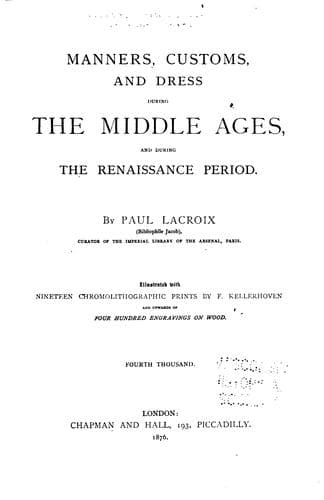
Manners, Customs, and Dress During the Middle Ages and During the Renaissance Period — John Shaqi
Manners, Customs, and Dress During the Middle Ages and During the Renaissance PeriodJacob, P. L.
History
Manners, Customs, and Dress During the Middle Ages and During the Renaissance Period
Jacob, P. L.
Clothing and dress; Manners and customs; Middle Ages; Renaissance
Water Torture, The
Weight in Brass of the Fish-market at Mans, Sixteenth Century
Whale Fishing
William, Duke of Normandy, Eleventh Century
Winegrower, The
Wire-worker
Wolves, how they may be caught with a Snare
Woman under the Safeguard of Knighthood, Fifteenth Century
Women of the Court, Sixth to Tenth Century
Woodcock, Mode of catching a, Fourteenth Century
Manners, Customs, and Dress During the Middle Ages, and During the
Renaissance Period.
Condition of Persons and Lands.
Disorganization of the West at the Beginning of the Middle
Ages.--Mixture of Roman, Germanic, and Gallic Institutions.--Fusion
organized under Charlemagne.--Royal Authority.--Position of the Great
Feudalists.--Division of the Territory and Prerogatives attached to
Landed Possessions.--Freemen and Tenants.--The Læti, the Colon, the
Serf, and the Labourer, who may be called the Origin of the Modern Lower
Classes.--Formation of Communities.--Right of Mortmain.
The period known as the Middle Ages, says the learned Benjamin Guérard, is
the produce of Pagan civilisation, of Germanic barbarism, and of
Christianity. It began in 476, on the fall of Agustulus, and ended in
1453, at the taking of Constantinople by Mahomet II., and consequently the
fall of two empires, that of the West and that of the East, marks its
duration. Its first act, which was due to the Germans, was the destruction
of political unity, and this was destined to be afterwards replaced by
religions unity. Then we find a multitude of scattered and disorderly
influences growing on the ruins of central power. The yoke of imperial
dominion was broken by the barbarians; but the populace, far from
acquiring liberty, fell to the lowest degrees of servitude. Instead of one
despot, it found thousands of tyrants, and it was but slowly and with
much trouble that it succeeded in freeing itself from feudalism. Nothing
could be more strangely troubled than the West at the time of the
dissolution of the Empire of the Caesars; nothing more diverse or more
discordant than the interests, the institutions, and the state of society,
which were delivered to the Germans (Figs. 1 and 2). In fact, it would be
impossible in the whole pages of history to find a society formed of more
heterogeneous or incompatible elements. On the one side might be placed
the Goths, Burgundians, Vandals, Germans, Franks, Saxons, and Lombards,
nations, or more strictly hordes, accustomed to rough and successful
warfare, and, on the other, the Romans, including those people who by long
servitude to Roman dominion had become closely allied with their
conquerors (Fig. 3). There were, on both sides, freemen, freedmen, colons,
and slaves; different ranks and degrees being, however, observable both in
freedom and servitude. This hierarchical principle applied itself even to
the land, which was divided into freeholds, tributary lands, lands of the
nobility, and servile lands, thus constituting the freeholds, the
Public-domain text, read in full here on John Shaqi.
Reviews
Reviews
No reviews yet
Be the first to share your thoughts on this work.
Join the Discussion
Join the discussion
Sign in to leave a comment or review.
Sign InorCreate an account