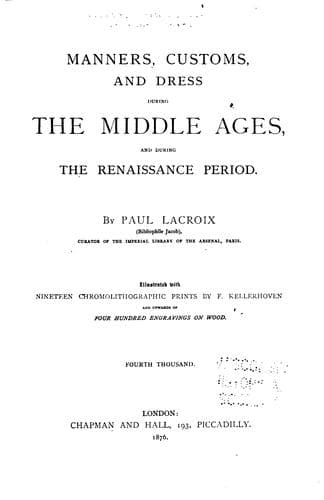
Manners, Customs, and Dress During the Middle Ages and During the Renaissance PeriodJacob, P. L.
History
Manners, Customs, and Dress During the Middle Ages and During the Renaissance Period
Jacob, P. L.
Clothing and dress; Manners and customs; Middle Ages; Renaissance
Dances were divided into two distinct classes--_danses basses_, or common
and regular dances, which did not admit of jumping, violent movements, or
extraordinary contortions--and the _danses par haut_, which were
irregular, and comprised all sorts of antics and buffoonery. The regular
French dance was a _basse_ dance, called the _gaillarde_; it was
accompanied by the sound of the hautbois and tambourine, and originally it
was danced with great form and state. This is the dance which Jean
Tabouret has described; it began with the two performers standing opposite
to each other, advancing, bowing, and retiring. "These advancings and
retirings were done in steps to the time of the music, and continued until
the instrumental accompaniment stopped; then the gentleman made his bow
to the lady, took her by the hand, thanked her, and led her to her seat."
The _tourdion_ was similar to the _gaillarde_, only faster, and was
accompanied with more action. Each province of France had its national
dance, such as the _bourrée_ of Auvergne, the _trioris_ of Brittany, the
_branles_ of Poitou, and the _valses_ of Lorraine, which constituted a
very agreeable pastime, and one in which the French excelled all other
nations. This art, "so ancient, so honourable, and so profitable," to use
the words of Jean Tabourot, was long in esteem in the highest social
circles, and the old men liked to display their agility, and the dames and
young ladies to find a temperate exercise calculated to contribute to
their health as well as to their amusement.
The sixteenth century was the great era of dancing in all the courts of
Europe; but under the Valois, the art had more charm and prestige at the
court of France than anywhere else. The Queen-mother, Catherine,
surrounded by a crowd of pretty young ladies, who composed what she called
her _flying squadron_, presided at these exciting dances. A certain
Balthazar de Beaujoyeux was master of her ballets, and they danced at the
Castle of Blois the night before the Duc de Guise was assassinated under
the eyes of Henry III., just as they had danced at the Château of the
Tuileries the day after St. Bartholomew's Day.
[Illustration: Fig. 188.--The Game of Bob Apple, or Swinging
Apple.--Manuscript of the Fourteenth Century, in the British Museum.]
Commerce.
State of Commerce after the Fall of the Roman. Empire.--Its Revival
under the Frankish Kings.--Its Prosperity under Charlemagne.--Its
Decline down to the Time of the Crusaders.--The Levant Trade of the
East.--Flourishing State of the Towns of Provence and
Languedoc.--Establishment of Fairs.--Fairs of Landit, Champagne,
Beaucaire, and Lyons.--Weights and Measures.--Commercial Flanders. Laws
of Maritime Commerce.--Consular Laws.--Banks and Bills of
Exchange.--French. Settlements on the Coast of Africa.--Consequences of
the Discovery of America.
Public-domain text, read in full here on John Shaqi.
Reviews
Reviews
No reviews yet
Be the first to share your thoughts on this work.
Elsewhere in the archive
Join the Discussion
Join the discussion
Sign in to leave a comment or review.
Sign InorCreate an account