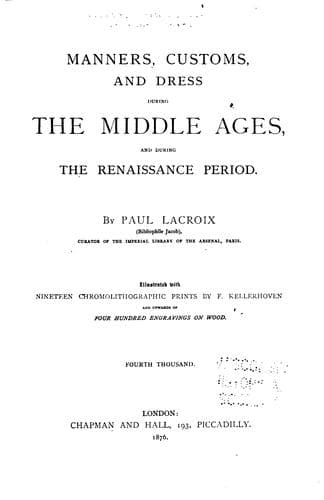
Manners, Customs, and Dress During the Middle Ages and During the Renaissance PeriodJacob, P. L.
History
Manners, Customs, and Dress During the Middle Ages and During the Renaissance Period
Jacob, P. L.
Clothing and dress; Manners and customs; Middle Ages; Renaissance
These _missi dominici_ were too much hated by the great vassals to outlive
the introduction of the feudal system. Their royal masters, as they
themselves gradually lost a part of their own privileges and power, could
not sustain the authority of these officers. Dukes, counts, and barons,
having become magistrates, arbitrarily levied new taxes, imposed new
fines, and appropriated the King's tributes to such an extent that,
towards the end of the tenth century, the laws of Charlemagne had no
longer any weight. We then find a number of new taxes levied for the
benefit of the nobles, the very names of which have fallen into disuse
with the feudal claims which they represented. Among these new taxes were
those of _escorte_ and _entrée_, of _mortmain_, of _lods et ventes_, of
_relief_, the _champarts_, the _taille_, the _fouage_, and the various
fees for wine-pressing, grinding, baking, &c., all of which were payable
without prejudice to the tithes due to the King and the Church. However,
as the royal tithe was hardly ever paid, the kings were obliged to look to
other means for replenishing their treasuries; and coining false money was
a common practice. Unfortunately each great vassal vied with the kings in
this, and to such an extent, that the enormous quantity of bad money
coined during the ninth century completed the public ruin, and made this a
sad period of social chaos. The freeman was no longer distinguishable from
the villain, nor the villain from the serf. Serfdom was general; men found
themselves, as it were, slaves, in possession of land which they laboured
at with the sweat of their brow, only to cultivate for the benefit of
others. The towns even--with the exception of a few privileged cities, as
Florence, Paris, Lyons, Rheims, Metz, Strasburg, Marseilles, Hamburg,
Frankfort, and Milan--were under the dominion of some ecclesiastical or
lay lord, and only enjoyed liberty of a more or less limited character.
Public-domain text, read in full here on John Shaqi.
Reviews
Reviews
No reviews yet
Be the first to share your thoughts on this work.
Elsewhere in the archive
Join the Discussion
Join the discussion
Sign in to leave a comment or review.
Sign InorCreate an account