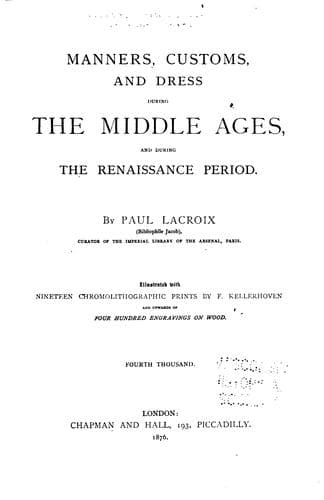
Manners, Customs, and Dress During the Middle Ages and During the Renaissance PeriodJacob, P. L.
History
Manners, Customs, and Dress During the Middle Ages and During the Renaissance Period
Jacob, P. L.
Clothing and dress; Manners and customs; Middle Ages; Renaissance
Towards the end of the eleventh century, under Philip I., the enthusiasm
for Crusades became general, and, as all the nobles joined in the holy
mission of freeing the tomb of Jesus Christ from the hands of the
infidels, large sums of money were required to defray the costs. New taxes
were accordingly imposed; but, as these did not produce enough at once,
large sums were raised by the sale of some of the feudal rights. Certain
franchises were in this way sold by the nobles to the boroughs, towns, and
abbeys, though, in not a few instances, these very privileges had been
formerly plundered from the places to which they were now sold. Fines were
exacted from any person declining to go to Palestine; and foreign
merchants--especially the Jews--were required to subscribe large sums. A
number of the nobles holding fiefs were reduced to the lowest expedients
with a view to raising money, and even sold their estates at a low price,
or mortgaged them to the very Jews whom they taxed so heavily. Every town
in which the spirit of Gallo-Roman municipality was preserved took
advantage of these circumstances to extend its liberties. Each monarch,
too, found this a favourable opportunity to add new fiefs to the crown,
and to recall as many great vassals as possible under his dominion. It
was at this period that communities arose, and that the first charters of
freedom which were obligatory and binding contracts between the King and
the people, date their origin. Besides the annual fines due to the King
and the feudal lords, and in addition to the general subsidies, such as
the quit-rent and the tithes, these communities had to provide for the
repair of the walls or ramparts, for the paving of the streets, the
cleaning of the pits, the watch on the city gates, and the various
expenses of local administration.
Louis le Gros endeavoured to make a re-arrangement of the taxes, and to
establish them on a definite basis. By his orders a new register of the
lands throughout the kingdom was commenced, but various calamities caused
this useful measure to be suspended. In 1149, Louis le Jeune, in
consequence of a disaster which had befallen the Crusaders, did what none
of his predecessors had dared to attempt: he exacted from all his subjects
a sol per pound on their income. This tax, which amounted to a twentieth
part of income, was paid even by the Church, which, for example's sake,
did not take advantage of its immunities. Forty years later, at a council,
or _great parliament_, called by Philip Augustus, a new crusade was
decided upon; and, under the name of Saladin's tithe, an annual tax was
imposed on all property, whether landed or personal, of all who did not
take up the cross to go to the Holy Land. The nobility, however, so
violently resisted this, that the King was obliged to substitute for it a
general tax, which, although it was still more productive, was less
offensive in its mode of collection.
Public-domain text, read in full here on John Shaqi.
Reviews
Reviews
No reviews yet
Be the first to share your thoughts on this work.
Elsewhere in the archive
Join the Discussion
Join the discussion
Sign in to leave a comment or review.
Sign InorCreate an account