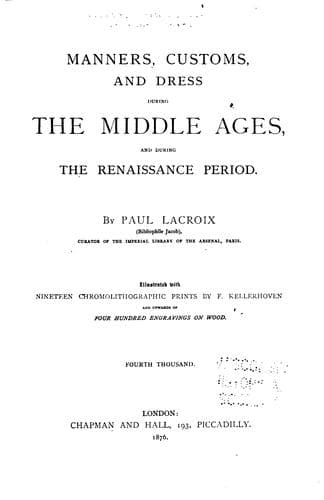
Manners, Customs, and Dress During the Middle Ages and During the Renaissance PeriodJacob, P. L.
History
Manners, Customs, and Dress During the Middle Ages and During the Renaissance Period
Jacob, P. L.
Clothing and dress; Manners and customs; Middle Ages; Renaissance
The finances were, notwithstanding these additions, in a low and
unsatisfactory condition, which became worse and worse from the fatal day
of Poitiers, when King John fell into the hands of the English. The
States-General were summoned by the Dauphin, and, seeing the desperate
condition in which the country was placed, all classes freely opened their
purses. The nobility, who had already given their blood, gave the produce
of all their feudal dues besides. The church paid a tenth and a half, and
the bourgeois showed the most noble unselfishness, and rose as one man to
find means to resist the common enemy. The ransom of the King had been
fixed at three millions of _écus d'or,_ nearly a thousand million francs,
payable in six years, and the peace of Bretigny was concluded by the
cession of a third of the territory of France. There was, however, cause
for congratulation in this result, for "France was reduced to its utmost
extremity," says a chronicler, "and had not something led to a reaction,
she must have perished irretrievably."
King John, grateful for the love and devotion shown to him by his subjects
under these trying circumstances, returned from captivity with the solemn
intention of lightening the burdens which pressed upon them, and in
consequence be began by spontaneously reducing the enormous wages which
the tax-gatherers had hitherto received, and by abolishing the tolls on
highways. He also sold to the Jews, at a very high price, the right of
remaining in the kingdom and of exercising any trade in it, and by this
means he obtained a large sum of money. He solemnly promised never again
to debase the coin, and he endeavoured to make an equitable division of
the taxes. Unfortunately it was impossible to do without a public revenue,
and it was necessary that the royal ransom should be paid off within six
years. The people, from whom taxes might be always extorted at pleasure,
paid a good share of this, for the fifth of the three millions of _écus
d'or_ was realised from the tax on salt, the thirteenth part from the
duty on the sale of fermented liquors, and twelve deniers per pound from
the tax on the value of all provisions sold and resold within the kingdom.
Commerce was subjected to a new tax called _imposition foraine_, a measure
most detrimental to the trade and manufactures of the country, which were
continually struggling under the pitiless oppression of the treasury.
Royal despotism was not always able to shelter itself under the sanction
of the general and provincial councils, and a few provinces, which
forcibly protested against this excise duty, were treated on the same
footing as foreign states with relation to the transit of merchandise from
them. Other provinces compounded for this tax, and in this way, owing to
the different arrangements in different places, a complicated system of
exemptions and prohibitions existed which although most prejudicial to all
industry, remained in force to a great extent until 1789.
Public-domain text, read in full here on John Shaqi.
Reviews
Reviews
No reviews yet
Be the first to share your thoughts on this work.
Elsewhere in the archive
Join the Discussion
Join the discussion
Sign in to leave a comment or review.
Sign InorCreate an account