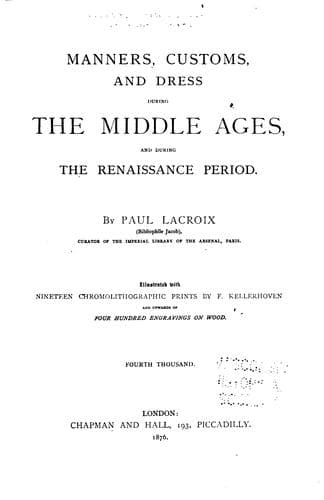
Manners, Customs, and Dress During the Middle Ages and During the Renaissance PeriodJacob, P. L.
History
Manners, Customs, and Dress During the Middle Ages and During the Renaissance Period
Jacob, P. L.
Clothing and dress; Manners and customs; Middle Ages; Renaissance
When Charles V.--surnamed the Wise--ascended the throne in 1364, France,
ruined by the disasters of the war, by the weight of taxation, by the
reduction in her commerce, and by the want of internal security, exhibited
everywhere a picture of misery and desolation; in addition to which,
famine and various epidemics were constantly breaking out in various parts
of the kingdom. Besides this, the country was incessantly overrun by gangs
of plunderers, who called themselves _écorcheurs, routiers, tardvenus_,
&c., and who were more dreaded by the country people even than the English
had been. Charles V., who was celebrated for his justice and for his
economical and provident habits, was alone capable of establishing order
in the midst of such general confusion. Supported by the vote of the
Assembly held at Compiègne in 1367, he remitted a moiety of the salt tax
and diminished the number of the treasury agents, reduced their wages, and
curtailed their privileges. He inquired into all cases of embezzlement, so
as to put a stop to fraud; and he insisted that the accounts of the public
expenditure in its several departments should be annually audited. He
protected commerce, facilitated exchanges, and reduced, as far as
possible, the rates and taxes on woven articles and manufactured goods. He
permitted Jews to hold funded property, and invited foreign merchants to
trade with the country. For the first time he required all gold and silver
articles to be stamped, and called in all the old gold and silver coins,
in order that by a new and uniform issue the value of money might no
longer be fictitious or variable. For more than a century coins had so
often changed in name, value, and standard weight, that in an edict of
King John we read, "It was difficult for a man when paying money in the
ordinary course to know what he was about from one day to another."
Public-domain text, read in full here on John Shaqi.
Reviews
Reviews
No reviews yet
Be the first to share your thoughts on this work.
Elsewhere in the archive
Join the Discussion
Join the discussion
Sign in to leave a comment or review.
Sign InorCreate an account