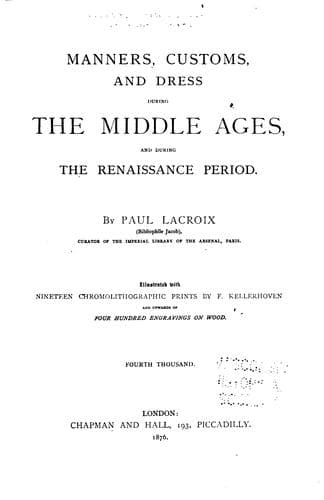
Manners, Customs, and Dress During the Middle Ages and During the Renaissance PeriodJacob, P. L.
History
Manners, Customs, and Dress During the Middle Ages and During the Renaissance Period
Jacob, P. L.
Clothing and dress; Manners and customs; Middle Ages; Renaissance
It is curious to notice with what ingenuity and how readily Parliament
took advantage of the most trifling circumstances or of charges based upon
the very slightest grounds to summon the officers of the Châtelet before
its bar on suspicion of prevarication or of outrages against religion,
morals, or the laws. Often were these officers and the provost himself
summoned to appear and make _amende honourable_ before the assembly,
notwithstanding which they retained their offices. More than once an
officer of the Châtelet was condemned to death and executed, but the King
always annulled that part of the sentence which had reference to the
confiscation of the goods of the condemned, thus proving that in reality
the condemnation had been unjust, although for grave reasons the royal
authority had been unable to save the victim from the avenging power of
Parliament. Hugues Aubriot, the provost, was thus condemned to
imprisonment for life on the most trivial grounds, and he would have
undergone capital punishment if Charles V. had abandoned him at the time
of his trial. During the English occupation, in the disastrous reign of
Charles VI., the Châtelet of Paris, which took part with the people, gave
proof of extraordinary energy and of great force of character. The blood
of many of its members was shed on the scaffold, and this circumstance
must ever remain a reproach to the judges and to those who executed their
cruel sentences, and a lasting crown of glory to the martyrs themselves.
Public-domain text, read in full here on John Shaqi.
Reviews
Reviews
No reviews yet
Be the first to share your thoughts on this work.
Elsewhere in the archive
Join the Discussion
Join the discussion
Sign in to leave a comment or review.
Sign InorCreate an account