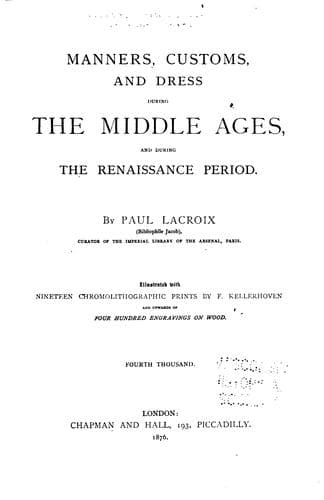
Manners, Customs, and Dress During the Middle Ages and During the Renaissance Period — John Shaqi
Manners, Customs, and Dress During the Middle Ages and During the Renaissance PeriodJacob, P. L.
History
Manners, Customs, and Dress During the Middle Ages and During the Renaissance Period
Jacob, P. L.
Clothing and dress; Manners and customs; Middle Ages; Renaissance
In no case could a community such as this exist without the sanction of
the King, who placed it under the safeguard of the Crown. At first the
kings, blinded by a covetous policy, only seemed to see in the issue of
these charters an excellent pretext for extorting money. If they consented
to recognise them, and even to help them against their lords, it was on
account of the enormous sacrifices made by the towns. Later on, however,
they affected, on the contrary, the greatest generosity towards the
vassals who wished to incorporate themselves, when they had understood
that these institutions might become powerful auxiliaries against the
great titulary feudalists; but from the reign of Louis XI., when the power
of the nobles was much diminished, and no longer inspired any terror to
royalty, the kings turned against their former allies, the middle classes,
and deprived them successively of all the prerogatives which could
prejudice the rights of the Crown.
The middle classes, it is true, acquired considerable influence afterwards
by participation in the general and provincial councils. After having
victoriously struggled against the clergy and nobility, in the assemblies
of the three states or orders, they ended by defeating royalty itself.
Louis le Gros, in whose orders the style or title of _bourgeois_ first
appears (1134), is generally looked upon as the founder of the franchise
of communities in France; but it is proved that a certain number of
communities or corporations were already formally constituted, before his
accession to the throne.
The title of bourgeois was not, however, given exclusively to inhabitants
of cities. It often happened that the nobles, with the intention of
improving and enriching their domains, opened a kind of asylum, under the
attractive title of _Free Towns_, or _New Towns_, where they offered, to
all wishing to establish themselves, lands, houses, and a more or less
extended share of privileges, rights, and liberties. These congregations,
or families, soon became boroughs, and the inhabitants, though
agriculturists, took the name of bourgeois.
[Illustration: Fig. 21.--Costume of a Vilain or Peasant, Fifteenth
Century, from a Miniature of "La Danse Macabre," Manuscript 7310 of the
National Library of Paris.]
Public-domain text, read in full here on John Shaqi.
Reviews
Reviews
No reviews yet
Be the first to share your thoughts on this work.
Join the Discussion
Join the discussion
Sign in to leave a comment or review.
Sign InorCreate an account