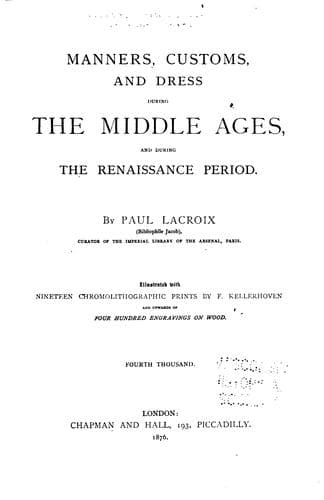
Manners, Customs, and Dress During the Middle Ages and During the Renaissance PeriodJacob, P. L.
History
Manners, Customs, and Dress During the Middle Ages and During the Renaissance Period
Jacob, P. L.
Clothing and dress; Manners and customs; Middle Ages; Renaissance
The chapter-general of the association was generally summoned once a year
by the emperor or his lieutenant, and assembled either at Dortmund or
Arensberg, in order to receive the returns of causes judged by the various
Vehmic tribunals; to hear the changes which had taken place among the
members of the order; to receive the free judges; to hear appeals; and,
lastly, to decide upon reforms to be introduced into the rules. These
reforms usually had reference to the connection of imperial authority with
the members of the secret jurisdiction, and were generally suggested by
the emperors, who were jealous of the increasing power of the association.
From what we have shown, on the authority of authentic documents, we
understand how untrue is the tradition, or rather the popular idea, that
the _Secret Tribunal_ was an assembly of bloodthirsty judges, secretly
perpetrating acts of mere cruelty, without any but arbitrary laws. It is
clear, on the contrary, that it was a regular institution, having, it is
true, a most mysterious and complex organization, but simply acting in
virtue of legal prescriptions, which were rigorously laid down, and
arranged in a sort of code which did honour to the wisdom of those who had
created it.
It was towards the end of the fourteenth and the beginning of the
fifteenth centuries that the Vehmic jurisdiction reached its highest
degree of power; its name was only pronounced in a whisper and with
trembling; its orders were received with immediate submission, and its
chastisements always fell upon the guilty and those who resisted its
authority. There cannot be a doubt but that the Westphalian tribunal
prevented many great crimes and public misfortunes by putting a wholesome
check on the nobles, who were ever ready to place themselves above all
human authority; and by punishing, with pitiless severity, the audacity of
bandits, who would otherwise have been encouraged to commit the most
daring acts with almost the certainty of escaping with impunity. But the
Holy Vehme, blinded by the terror it inspired, was not long without
displaying the most extravagant assumption of power, and digressing from
the strict path to which its action should have been confined. It summoned
before its tribunals princes, who openly denied its authority, and cities,
which did not condescend to answer to its behests. In the fifteenth
century, the free judges were composed of men who could not be called of
unimpeachable integrity; many persons of doubtful morals having been
raised to the dignity by party influence and by money. The partiality and
the spirit of revenge which at times prompted their judgments, were
complained of; they were accused of being open to corruption; and this
accusation appears to have been but too well founded. It is known that,
according to a feudal practice established in the Vehmic system, every
new free judge was obliged to make a present to the free count who had
Public-domain text, read in full here on John Shaqi.
Reviews
Reviews
No reviews yet
Be the first to share your thoughts on this work.
Elsewhere in the archive
Join the Discussion
Join the discussion
Sign in to leave a comment or review.
Sign InorCreate an account