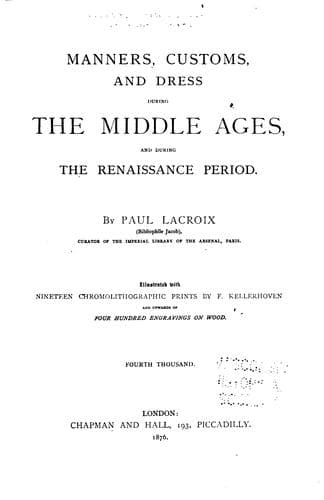
Manners, Customs, and Dress During the Middle Ages and During the Renaissance PeriodJacob, P. L.
History
Manners, Customs, and Dress During the Middle Ages and During the Renaissance Period
Jacob, P. L.
Clothing and dress; Manners and customs; Middle Ages; Renaissance
admitted him into the order; and the free counts did not hesitate to make
this an important source of revenue to themselves by admitting, according
to an historian, "many people as _judges_ who, in reality, deserved to be
_judged_."
[Illustration: Fig. 331.--View of Cologne in the Sixteenth Century.--From
a Copper-plate in the "Theatrum Geographicum" of P. Bertius. The three
large stars represent, it is supposed, the Three Persons of the Trinity,
and the seven small ones the Electors of the Empire.]
[Illustration: Fig. 332.--German Knights (Fifteenth Century).--From a
Plate in the "Life of the Emperor Maximilian," engraved by Burgmayer, from
Drawings by Albert Durer.]
Owing to the most flagrant and most insolent abuses of power, the ancient
authority of the institution became gradually more and more shaken. On one
occasion, for instance, in answer to a summons issued by the Imperial
Tribunal against some free judges, the tribunal of the Terre-Rouge had the
daring to summon the Emperor Frederick III. before it to answer for this
want of respect. On another occasion, a certain free count, jealous of one
of his associates, hung him with his own hands while out on a hunting
excursion, alleging that his rank of free judge authorised him to execute
summary justice. From that time there was a perpetual cry of horror and
indignation against a judicial institution which thus interpreted its
duties, and before long the State undertook the suppression of these
secret tribunals. The first idea of this was formed by the electors of the
empire at the diet of Trèves in 1512. The Archbishop of Cologne succeeded,
however, in parrying the blow, by convoking the chapter-general of the
order, on the plea of the necessity of reform. But, besides being
essentially corrupt, the Holy Vehme had really run its course, and it
gradually became effete as, by degrees, a better organized and more
defined social and political state succeeded to the confused anarchy of
the Middle Ages, and as the princes and free towns adopted the custom of
dispensing justice either in person or through regular tribunals. Its
proceedings, becoming more and more summary and rigorous, daily gave rise
to feelings of greater and greater abhorrence. The common saying over all
Germany was, "They first hang you, and afterwards inquire into your
innocence." On all sides opposition arose against the jurisdiction of the
free judges. Princes, bishops, cities, and citizens, agreed instinctively
to counteract this worn-out and degenerate institution. The struggle was
long and tedious. During the last convulsions of the expiring Holy Vehme,
there was more than one sanguinary episode, both on the side of the free
judges themselves, as well as on that of their adversaries. Occasionally
the secret tribunal broke out into fresh signs of life, and proclaimed its
existence by some terrible execution; and at times, also, its members paid
dearly for their acts. On one occasion, in 1570, fourteen free judges,
Public-domain text, read in full here on John Shaqi.
Reviews
Reviews
No reviews yet
Be the first to share your thoughts on this work.
Elsewhere in the archive
Join the Discussion
Join the discussion
Sign in to leave a comment or review.
Sign InorCreate an account