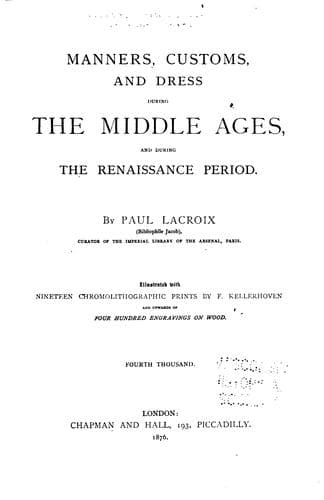
Manners, Customs, and Dress During the Middle Ages and During the Renaissance PeriodJacob, P. L.
History
Manners, Customs, and Dress During the Middle Ages and During the Renaissance Period
Jacob, P. L.
Clothing and dress; Manners and customs; Middle Ages; Renaissance
Like the Holy Vehme, the Council of Ten compromised its authority by the
abuse of power. In 1540, unknown to the Senate, and in spite of the
well-prescribed limit of its authority, it concluded a treaty with the
Turkish Sultan, Soliman II. The Senate at first concealed its indignation
at this abuse of power, but, in 1582, it took measures so as considerably
to restrain the powers of the Council of Ten, which, from that date, only
existed in name.
[Illustration: Fig. 339.--Seal of the Free Count Heinrich Beckmann, of
Medebach. (1520--1533).]
Punishments.
Refinements of Penal Cruelty.--Tortures for different Purposes.--Water,
Screw-boards, and the Rack.--The Executioner.--Female
Executioners.--Tortures.--Amende Honorable.--Torture of Fire, Real and
Feigned.--Auto-da-fé.--Red-hot Brazier or
Basin.--Beheading.--Quartering.--Wheel.--Garotte.--Hanging.--The
Whip.--The Pillory.--The
Arquebuse.--Tickling.--Flaying.--Drowning.--Imprisonment.--Regulations
of Prisons.--The Iron Cage.--The Leads of Venice.
"It is very sad," says the learned M. de Villegille, "to observe the
infinite variety of tortures which have existed since the beginning of the
world. It is, in fact, difficult to realise the amount of ingenuity
exercised by men in inventing new tortures, in order to give themselves
the satisfaction of seeing their fellow-creatures agonizing in the most
awful sufferings."
In entering upon the subject of ancient modes of punishment, we must first
speak of the torture, which, according to the received phrase, might be
either _previous_ or _preparatory: previous_, when it consisted of a
torture which the condemned had to endure previous to capital punishment;
and _preparatory_, when it was applied in order to elicit from the culprit
an avowal of his crime, or of that of his accomplices. It was also called
_ordinary_, or _extraordinary_, according to the duration or violence with
which it was inflicted. In some cases the torture lasted five or six
consecutive hours; in others, it rarely exceeded an hour. Hippolyte de
Marsillis, the learned and venerable jurisconsult of Bologna, who lived at
the beginning of the fifteenth century, mentions fourteen ways of
inflicting torture. The compression of the limbs by special instruments,
or by ropes only; injection of water, vinegar, or oil, into the body of
the accused; application of hot pitch, and starvation, were the processes
most in use. Other means, which were more or less applied according to the
fancy of the magistrate and the tormentor or executioner, were remarkable
for their singular atrocities. For instance, placing hot eggs under the
arm-pits; introducing dice between the skin and flesh; tying lighted
candles to the fingers, so that they might be consumed simultaneously with
the wax; letting water trickle drop by drop from a great height on the
stomach; and also the custom, which was, according to writers on criminal
Public-domain text, read in full here on John Shaqi.
Reviews
Reviews
No reviews yet
Be the first to share your thoughts on this work.
Elsewhere in the archive
Join the Discussion
Join the discussion
Sign in to leave a comment or review.
Sign InorCreate an account