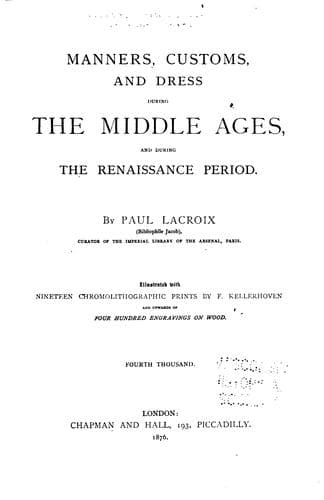
Manners, Customs, and Dress During the Middle Ages and During the Renaissance Period — John Shaqi
Manners, Customs, and Dress During the Middle Ages and During the Renaissance PeriodJacob, P. L.
History
Manners, Customs, and Dress During the Middle Ages and During the Renaissance Period
Jacob, P. L.
Clothing and dress; Manners and customs; Middle Ages; Renaissance
Toulouse had to pay dearly for the respect shown to its municipal dignity.
The parents of the student presented a petition to the King against the
city, for having dared to execute a noble and to hang his body on a
gibbet, in opposition to the sacred right which this noble had of
appealing to the judgment of his peers. The Parliament of Paris finally
decided the matter with the inflexible partiality to the rights of rank,
and confiscated all the goods of the inhabitants, forced the principal
magistrates to go on their knees before the house of Aimeri de Bérenger,
and ask pardon; themselves to take down the body of the victim, and to
have it publicly and honourably buried in the burial-ground of the
Daurade. Such was the sentence and humiliation to which one of the first
towns of the south was subjected, for having practised immediate justice
on a noble, whilst it would certainly have suffered no vindication, if the
culprit condemned to death had belonged to the middle or lower orders.
We must nevertheless remember that heavy dues fell upon the privileged
class themselves to a certain degree, and that if they taxed their poor
vassals without mercy, they had in their turn often to reckon with their
superiors in the feudal hierarchy.
_Albere_, or right of shelter, was the principal charge imposed upon the
noble. When a great baron visited his lands, his tenants were not only
obliged to give him and his followers shelter, but also provisions and
food, the nature and quality of which were all arranged beforehand with
the most extraordinary minuteness. The lesser nobles took advantage
sometimes of the power they possessed to repurchase this obligation; but
the rich, on the contrary, were most anxious to seize the occasion of
proudly displaying before their sovereign all the pomp in their power, at
the risk even of mortgaging their revenues for several years, and of
ruining their vassals. History is full of stories bearing witness to the
extravagant prodigalities of certain nobles on such occasions.
Payments in kind fell generally on the abbeys, up to 1158. That of St.
Denis, which was very rich in lands, was charged with supplying the house
and table of the King. This tax, which became heavier and heavier,
eventually fell on the Parisians, who only succeeded in ridding themselves
of it in 1374, when Charles V. made all the bourgeois of Paris noble. In
the twelfth century, all furniture made of wood or iron which was found in
the house of the Bishop at his death, became the property of the King. But
in the fourteenth century, the abbots of St. Denis, St. Germain des Prés,
St. Geneviève (Fig. 32), and a few priories in the neighbourhood of Paris,
were only required to present the sovereign with two horse-loads of
produce annually, so as to keep up the old system of fines.
This system of rents and dues of all kinds was so much the basis of social
organization in the Middle Ages, that it sometimes happened that the lower
orders benefited by it.
Public-domain text, read in full here on John Shaqi.
Reviews
Reviews
No reviews yet
Be the first to share your thoughts on this work.
Join the Discussion
Join the discussion
Sign in to leave a comment or review.
Sign InorCreate an account