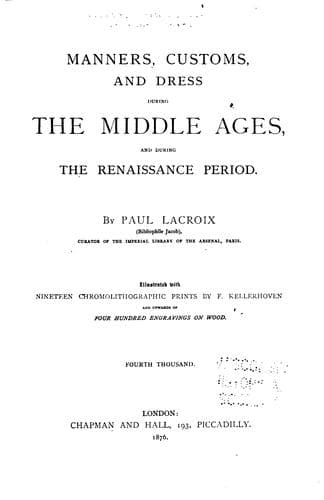
Manners, Customs, and Dress During the Middle Ages and During the Renaissance PeriodJacob, P. L.
History
Manners, Customs, and Dress During the Middle Ages and During the Renaissance Period
Jacob, P. L.
Clothing and dress; Manners and customs; Middle Ages; Renaissance
At Périgueux, the young couples had to give the consuls a pincushion of
embossed leather or cloth of different colours; a woman marrying a second
time was required to present them with an earthen pot containing twelve
sticks of different woods; a woman marrying for the third time, a barrel
of cinders passed thirteen times through the sieve, and thirteen spoons
made of wood of fruit-trees; and, lastly, one coming to the altar for the
fifth time was obliged to bring with her a small tub containing the
excrement of a white hen!
"The people of the Middle Ages and the Renaissance period were literally
tied down with taxes and dues of all sorts," says M. Mary-Lafon. "If a few
gleams of liberty reached them, it was only from a distance, and more in
the hope of the future than as regarded the present. As an example of the
way people were treated, a certain Lord of Laguène, spoken of in the old
chronicles of the south, may be mentioned. Every year, this cunning baron
assembled his tenants in the village square. A large maypole was planted,
and on the top was attached a wren. The lord, pointing to the little bird,
declared solemnly, that if any 'vilain' succeeded in piercing him with an
arrow he should be exempt from that year's dues. The vilains shot away,
but, to the great merriment of their lord, never hit, and so had to
continue paying the dues."
[Illustration: Fig. 33.--Ramparts of the Town of Aigues-Mortes, one of the
Municipalities of Languedoc.]
One can easily understand how such a system, legalised by law, hampered
the efforts for freedom, which a sense of human dignity was constantly
raising in the bosoms of the oppressed. The struggle was long, often
bloody, and at times it seemed almost hopeless, for on both sides it was
felt that the contest was between two principles which were incompatible,
and one of which must necessarily end by annihilating the other. Any
compromise between the complete slavery and the personal freedom of the
lower orders, could only be a respite to enable these implacable
adversaries to reinforce themselves, so as to resume with more vigour than
ever this desperate combat, the issue of which was so long to remain
doubtful.
[Illustration: Louis IV Leaving Alexandria on the 24th of April 1507 To
chastise the city of Genoa.
From a miniature by Jean Marot. No 5091, Bibl. nat'le de Paris.]
These efforts to obtain individual liberty displayed themselves more
particularly in towns; but although they became almost universal in the
west, they had not the same importance or character everywhere. The feudal
system had not everywhere produced the same consequences. Thus, whilst in
ancient Gaul it had absorbed all social vitality, we find that in Germany,
the place of its origin, the Teutonic institutions of older date gave a
comparative freedom to the labourers. In southern countries again we find
the same beneficial effect from the Roman rule.
Public-domain text, read in full here on John Shaqi.
Reviews
Reviews
No reviews yet
Be the first to share your thoughts on this work.
Join the Discussion
Join the discussion
Sign in to leave a comment or review.
Sign InorCreate an account