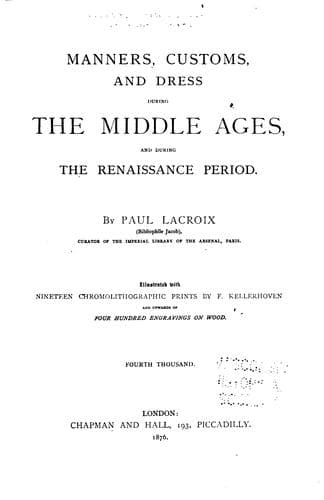
Manners, Customs, and Dress During the Middle Ages and During the Renaissance PeriodJacob, P. L.
History
Manners, Customs, and Dress During the Middle Ages and During the Renaissance Period
Jacob, P. L.
Clothing and dress; Manners and customs; Middle Ages; Renaissance
The author states that on questioning one of the peasants to ascertain who
was the cleverest person present, the following dialogue took place: "The
one you see leaning on his elbow, hitting his boots, which have white
strings, with a hazel stick, is called Anselme; he is one of the rich ones
of the village, he is a good workman, and not a bad writer for the flat
country; and the one you see by his side, with his thumb in his belt,
hanging from which is a large game bag, containing spectacles and an old
prayer book, is called Pasquier, one of the greatest wits within a day's
journey--nay, were I to say two I should not be lying. Anyhow, he is
certainly the readiest of the whole company to open his purse to give
drink to his companions." "And that one," I asked, "with the large
Milanese cap on his head, who holds an old book?" "That one," he answered,
"who is scratching the end of his nose with one hand and his beard with
the other?" "That one," I replied, "and who has turned towards us?" "Why,"
said he, "that is Roger Bontemps, a merry careless fellow, who up to the
age of fifty kept the parish school; but changing his first trade he has
become a wine-grower. However, he cannot resist the feast days, when he
brings us his old books, and reads to us as long as we choose, such works
as the 'Calondrier des Bergers,' 'Fables d'Esope,' 'Le Roman de la Rose,'
'Matheolus,' 'Alain Chartier,' 'Les Vigiles du feu Roy Charles,' 'Les deux
Grebans,' and others. Neither, with his old habit of warbling, can he help
singing on Sundays in the choir; and he is called Huguet. The other
sitting near him, looking over his shoulder into his book, and wearing a
sealskin belt with a yellow buckle, is another rich peasant of the
village, not a bad villain, named Lubin, who also lives at home, and is
called the little old man of the neighbourhood."
After this artistic sketch, the author dilates on the goodman Anselme. He
says: "This good man possessed a moderate amount of knowledge, was a
goodish grammarian, a musician, somewhat of a sophist, and rather given to
picking holes in others." Some of Anselme's conversation is also given,
and after beginning by describing in glowing terms the bygone days which
he and his contemporaries had seen, and which he stated to be very
different to the present, he goes on to say, "I must own, my good old
friends, that I look back with pleasure on our young days; at all events
the mode of doing things in those days was very superior and better in
every way to that of the present.... O happy days! O fortunate times when
our fathers and grandfathers, whom may God absolve, were still among us!"
As he said this, he would raise the rim of his hat. He contented himself
as to dress with a good coat of thick wool, well lined according to the
fashion; and for feast days and other important occasions, one of thick
cloth, lined with some old gabardine.
Public-domain text, read in full here on John Shaqi.
Reviews
Reviews
No reviews yet
Be the first to share your thoughts on this work.
Elsewhere in the archive
Join the Discussion
Join the discussion
Sign in to leave a comment or review.
Sign InorCreate an account