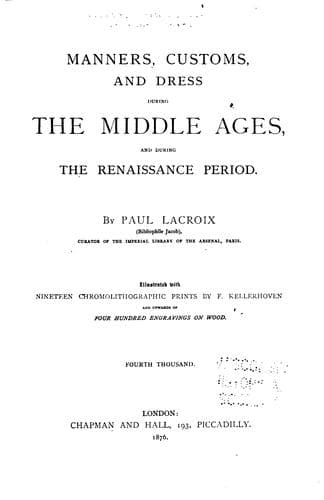
Manners, Customs, and Dress During the Middle Ages and During the Renaissance PeriodJacob, P. L.
History
Manners, Customs, and Dress During the Middle Ages and During the Renaissance Period
Jacob, P. L.
Clothing and dress; Manners and customs; Middle Ages; Renaissance
[Illustration: Fig. 70.--The Shepherds celebrating the Birth of the
Messiah by Songs and Dances.--Fifteenth Century.--Fac-simile of an
Engraving on Wood, from a Book of Hours, printed by Anthony Verard.]
"So we see," says M. Le Roux de Lincy, "at the end of the fifteenth
century that the old peasants complained of the changes in the village
customs, and of the luxury which every one wished to display in his
furniture or apparel. On this point it seems that there has been little
or no change. We read that, from the time of Homer down to that of the
excellent author of 'Rustic Discourses,' and even later, the old people
found fault with the manners of the present generation and extolled those
of their forefathers, which they themselves had criticized in their own
youth."
[Illustration: Fig. 71.--Purse or Leather Bag, with Knife or Dagger of the
Fifteenth Century.]
Food and Cookery.
History of Bread.--Vegetables and Plants used in
Cooking.--Fruits.--Butchers' Meat.--Poultry, Game.--Milk, Butter,
Cheese, and Eggs.--Fish and Shellfish.--Beverages, Beer, Cider, Wine,
Sweet Wine, Refreshing Drinks, Brandy.--Cookery.--Soups, Boiled Food,
Pies, Stews, Salads, Roasts, Grills.--Seasoning, Truffles, Sugar,
Verjuice.--Sweets, Desserts, Pastry.--Meals and Feasts.--Rules of
Serving at Table from the Fifteenth to the Sixteenth Centuries.
"The private life of a people," says Legrand d'Aussy, who had studied that
of the French from a gastronomic point of view only, "from the foundation
of monarchy down to the eighteenth century, must, like that of mankind
generally, commence with obtaining the first and most pressing of its
requirements. Not satisfied with providing food for his support, man has
endeavoured to add to his food something which pleased his taste. He does
not wait to be hungry, but he anticipates that feeling, and aggravates it
by condiments and seasonings. In a word his greediness has created on this
score a very complicated and wide-spread science, which, amongst nations
which are considered civilised, has become most important, and is
designated the culinary art."
At all times the people of every country have strained the nature of the
soil on which they lived by forcing it to produce that which it seemed
destined ever to refuse them. Such food as human industry was unable to
obtain from any particular soil or from any particular climate, commerce
undertook to bring from the country which produced it. This caused
Rabelais to say that the stomach was the father and master of industry.
We will rapidly glance over the alimentary matters which our forefathers
obtained from the animal and vegetable kingdom, and then trace the
progress of culinary art, and examine the rules of feasts and such matters
as belong to the epicurean customs of the Middle Ages.
Aliments.
Public-domain text, read in full here on John Shaqi.
Reviews
Reviews
No reviews yet
Be the first to share your thoughts on this work.
Elsewhere in the archive
Join the Discussion
Join the discussion
Sign in to leave a comment or review.
Sign InorCreate an account