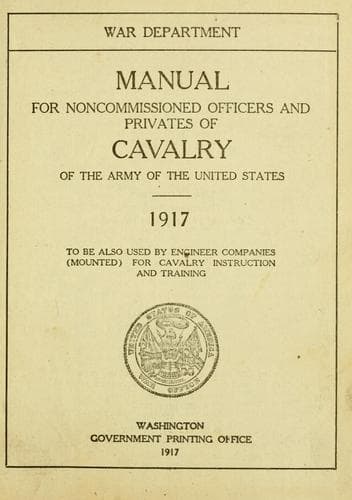
Manual for Noncommissioned Officers and Privates of Cavalry of the Army: of the United States 1917. To be also used by Engineer Companies (Mounted) for Cavalry Instruction and TrainingUnited States. War Department
History
Manual for Noncommissioned Officers and Privates of Cavalry of the Army: of the United States 1917. To be also used by Engineer Companies (Mounted) for Cavalry Instruction and Training
United States. War Department
United States. Army -- Handbooks, manuals, etc.
The _squad_ executes =assemble= only when deployed as foragers and =in
order=. Under other conditions the rally (par. 416), followed, by
=count fours=, more easily accomplishes the purposes of the =assembly=
(Def.).
In executing the assembly dismounted the troopers close in on the
guide in double time _without special command_ if the guide and leader
continue to advance (par. 339-_g_); otherwise they close in at quick
time unless double time be commanded (par. 339-_b_). (Fig. 42.)
[Illustration: FIG. 48, par. 414.]
=415.= If =to the rear= (par. 412) be executed by the squad, a
temporary loss of =order= occurs. If it be desired to pass to close
order without resuming the march to the front and assembling (par.
414), the squad may rally (par. 416) and count fours.
=416.= =Being in any formation, or not formed, or in disorder, to
rally=; =RALLY=. _When the rally is ordered the signal is habitually
accompanied by the oral command, both the signal and the oral command,
being repeated until understood and obeyed. The signal is obeyed at
once, there being no preparatory command for this movement._
The leader takes position at any point or moves in any desired
direction, and at any gait that will permit the movement to be
executed. The troopers ride toward the leader at an extended gallop
and, in the absence of other indication, form in rear of the leader in
line. The leader promptly designates the guide (pars. 371, 373), who
follows the leader. The other troopers form, as they come up, on the
right and left of the guide extending the line. The leader may
caution: =COLUMN=, as the leading troopers approach. The troopers then
form in =column of fours= instead of in =line=. The leading element
forms first; the other troopers, as they arrive, successively form
fours, extending the column to the rear. The leader designates the
guide (pars. 373, 374) and cautions: =NOTE YOUR NUMBERS=. The rally in
column is exceptional and is intended for use only on occasions when a
narrow road or other circumstances of the terrain prevent the rally in
line.
Should the route along which the leader is moving when the rally is
ordered be too narrow to permit the formation of column of fours, the
leader may caution: =COLUMN OF TWOS (COLUMN OF TROOPERS)= as the
leading troopers approach. The movement is executed as explained for
the rally in column of fours. =Fours= should be counted at once. The
rally in columns of twos or troopers is to be regarded as very
exceptional.
The squad being rallied in line, though ordinarily not =in order=
until fours are counted (par. 470), is available at once to charge or
to execute any movement that does not involve a knowledge of their
respective numbers on the part of the individual troopers. Unless the
charge is to be executed at once, fours should be counted without
delay after rallying, so that the squad, may be =in order= and ready
to execute any movements whatever that conditions may demand.
Public-domain text, read in full here on John Shaqi.
Reviews
Reviews
No reviews yet
Be the first to share your thoughts on this work.
Elsewhere in the archive
Join the Discussion
Join the discussion
Sign in to leave a comment or review.
Sign InorCreate an account