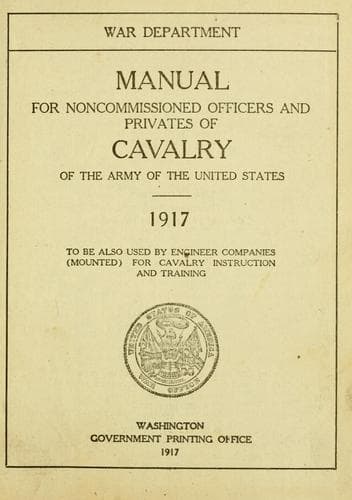
Manual for Noncommissioned Officers and Privates of Cavalry of the Army: of the United States 1917. To be also used by Engineer Companies (Mounted) for Cavalry Instruction and TrainingUnited States. War Department
History
Manual for Noncommissioned Officers and Privates of Cavalry of the Army: of the United States 1917. To be also used by Engineer Companies (Mounted) for Cavalry Instruction and Training
United States. War Department
United States. Army -- Handbooks, manuals, etc.
The rally dismounted, is always executed at a run. (Fig. 49.)
[Illustration: FIG. 49, par. 416.]
THE MOUNTED ATTACK.
=417.= The mounted attack is made with the pistol or saber in
accordance with the principles indicated in pars. 562-565. The typical
saber charge is executed in =line=. Under some circumstances, as in
the attack of a dispersed enemy, etc., a saber charge may be made by
troopers deployed as =foragers=. The pistol attack is usually made in
foragers. In exceptional circumstances (as in breaking out from an
ambush, attacking in a narrow road, etc.) it may be made =in line= or
=in column of fours, twos, or troopers=.
=418.= Cohesion in the line and vigor in the shock are essential to
the success of the _saber charge_. High speed is necessary for the
desired shock; and in the saber charge, as executed in combat, the
horses are, at the culmination of the charge, habitually "turned
loose" and urged to the highest speed. This, except with men and
horses that are highly trained, necessarily involves _loss of control_
over the horse on the part of the trooper. The saber charge, executed
with poorly trained horsemen, especially if on imperfectly trained or
excitable house's, is apt to be futile as regards the instruction of
the trooper and to result in more or less permanent loss of control
over the horses. _Control of the mount_ by the trooper is essential
during the execution of the _pistol attack_ (ordinarily made in line
of foragers), and is, of course, necessary during march and maneuver.
For these reasons it is considered advisable that the first
instruction of the recruit in the actual saber charge be deferred
until after platoon instruction and that it be given then only after
the troop commander is satisfied that the recruit's progress in
horsemanship and in the use of his weapon has advanced to a point when
the exercise will be of value.
Public-domain text, read in full here on John Shaqi.
Reviews
Reviews
No reviews yet
Be the first to share your thoughts on this work.
Elsewhere in the archive
Join the Discussion
Join the discussion
Sign in to leave a comment or review.
Sign InorCreate an account