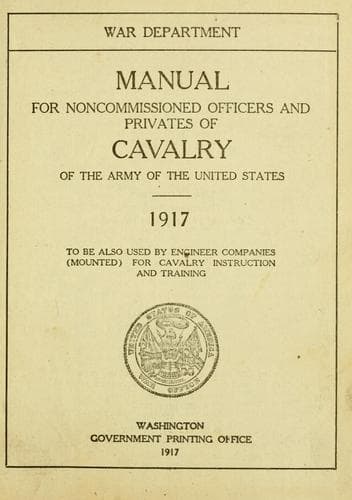
Manual for Noncommissioned Officers and Privates of Cavalry of the Army: of the United States 1917. To be also used by Engineer Companies (Mounted) for Cavalry Instruction and TrainingUnited States. War Department
History
Manual for Noncommissioned Officers and Privates of Cavalry of the Army: of the United States 1917. To be also used by Engineer Companies (Mounted) for Cavalry Instruction and Training
United States. War Department
United States. Army -- Handbooks, manuals, etc.
To pitch all types of Army tents, except shelter and conical wall
tents: Mark line of tents by driving, a wall pin on the spot to be
occupied by the right (or left) corner of each tent. For pyramidal
tents the interval between adjacent pins should be about 30 feet,
which will give a passage of 2 feet between tents. Spread tripod on
the ground where the center of tent is to be, if tripod is used.
Spread the tent on the ground to be occupied, door to the front, and
place the right (or left) front wall loop over the pin. The door (or
doors, if more than one) being fastened and held together at the
bottom, the left (or right) corner wall loop is carried to the left
(or right) as far as it will go and a wall pin driven through it, the
pin being placed in line with the right (or left) corner pins already
driven. At the same time the rear corner wall loops are pulled to the
rear and outward so that the rear wall of the tent is stretched to
complete the rectangle. Wall pins are then driven through these loops.
Each corner pin should be directly in rear of the corresponding front
corner pin, making a rectangle. Unless the canvas be wet, a small
amount of slack should be allowed before the corner pins are driven.
According to the size of the tent, one or two men, crawling under the
tent if necessary, fit each pole or ridge or upright into the ring or
ridge-pole holes, and such accessories as hood, fly, and brace ropes
are adjusted. If a tripod be used an additional man will go under the
tent to adjust it. The tent, steadied by the remaining men, one at
each corner guy rope, will then be raised. If the tent is a ward or
storage type, corner poles will now be placed at the four corners. The
four corner guy ropes are then placed over the lower notches of the
large pins driven in prolongation of the diagonals at such distance as
to hold the walls and ends of the tent vertical and smooth when the
guy ropes are drawn taut. A wall pin is then driven through each
remaining wall loop and a large pin for each guy rope is driven in
line with the corner guy pins already driven. The guy ropes of the
tent are placed over the lower notches, while the guy ropes of the fly
are placed over the upper notches, and are then drawn taut. Brace
ropes, when used, are then secured to stakes or pins suitably placed.
CONICAL WALL TENT.
Drive the door pin and center pin 8 feet 3 inches apart. Using the
hood lines, with center pin as center, describe two concentric
circles with radii 8 feet 3 inches and 11 feet 3 inches. In the outer
circle drive two door guy pins 3 feet apart. At intervals of about 3
feet drive the other guy pins.
In other respects conical tents are erected practically as in the case
of pyramidal tents.
TO STRIKE COMMON, WALL, PYRAMIDAL, AND CONICAL WALL TENTS.
=STRIKE TENTS.=
Public-domain text, read in full here on John Shaqi.
Reviews
Reviews
No reviews yet
Be the first to share your thoughts on this work.
Elsewhere in the archive
Join the Discussion
Join the discussion
Sign in to leave a comment or review.
Sign InorCreate an account