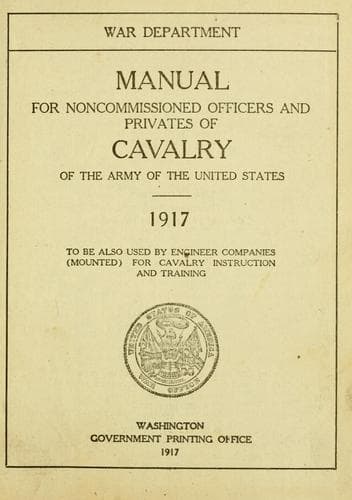
Manual for Noncommissioned Officers and Privates of Cavalry of the Army: of the United States 1917. To be also used by Engineer Companies (Mounted) for Cavalry Instruction and TrainingUnited States. War Department
History
Manual for Noncommissioned Officers and Privates of Cavalry of the Army: of the United States 1917. To be also used by Engineer Companies (Mounted) for Cavalry Instruction and Training
United States. War Department
United States. Army -- Handbooks, manuals, etc.
To guard against a flank attack or an enveloping attack the captain
may detach a platoon to move to the threatened flank so as to take an
enveloping attack in flank or meet a flank attack. If a flank platoon
be so designated, it acts on the corresponding flank unless otherwise
directed. When no platoon is specially designated for flank guard, the
corresponding duties fall upon the reserve.
=643.= The captain's commands should include an indication of the
objective, unless the latter is obvious, designate the elements of the
attack, and state any special mission that is assigned to any element.
The captain's orders also usually include an indication of the weapon
to be used by the several elements of the attack and may prescribe the
formations to be employed. All details not prescribed by the captain
are left to the discretion of the commanders of the several elements
into which the attack is divided.
Where the same weapon is to be used by all it is ordinarily drawn at
the captain's orders before the instructions for the attack are given.
Otherwise, each commander gives the proper orders for drawing saber
or raising pistol.
=644.= The troop being, for example, =in line=, marching at a gallop
with sabers drawn, the captain may command: =Objective, Cavalry in
front; Second and Third platoons, to the charge; First platoon, flank
attack; Fourth platoon, reserve.= Each element of the attack proceeds
at once to carry out its orders. The leader of the attacking line
(whether the captain or a lieutenant) directs the leader of the base
platoon to close on him before charge is ordered (par. 563). In other
respects, the charge is conducted as explained for the platoon (pars.
562-564).
The troop being, for example, in column of platoons, marching at a
gallop, no weapon drawn, the captain may command (the objective being
obvious): =First and Second platoons, pistol attack; Third platoon,
reserve; Fourth platoon, left flank guard.= The leader of the
attacking line commands: 1. =As foragers=, 2. =MARCH=, and attacks
with the pistol according to the principles explained for the platoon
(pars. 566-568) as soon as the second platoon completes its deployment
on the left of the first platoon. The commanders of the third and
fourth platoons move to their positions, drawing saber or raising
pistol in their discretion.
Should the captain command, for example: =First and Second platoons,
pistol attack in two lines; Third platoon, charge enemy's right flank;
Fourth platoon, reserve=, the third platoon may charge with the saber.
Should the captain cause pistols to be raised before ordering the
attack all use the pistol.
The above are only examples to indicate the character of the captain's
commands. The actual orders must meet the situation presented.
Public-domain text, read in full here on John Shaqi.
Reviews
Reviews
No reviews yet
Be the first to share your thoughts on this work.
Elsewhere in the archive
Join the Discussion
Join the discussion
Sign in to leave a comment or review.
Sign InorCreate an account