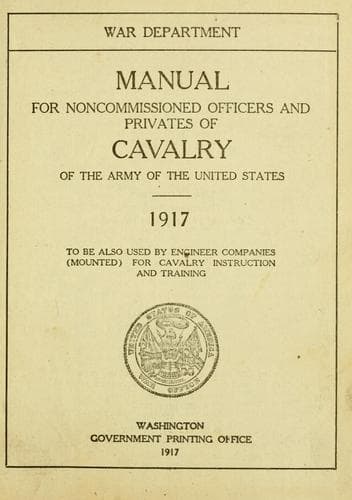
Manual for Noncommissioned Officers and Privates of Cavalry of the Army: of the United States 1917. To be also used by Engineer Companies (Mounted) for Cavalry Instruction and TrainingUnited States. War Department
History
Manual for Noncommissioned Officers and Privates of Cavalry of the Army: of the United States 1917. To be also used by Engineer Companies (Mounted) for Cavalry Instruction and Training
United States. War Department
United States. Army -- Handbooks, manuals, etc.
Second. =Never lose touch with your section.= Every individual, as
well as every unit, should always be acting under the control of some
higher commander. This is necessary if there is to be any unity of
action. Therefore if you lose your section or it becomes broken up,
join the first section you can find and obey your new section leader
as loyally and as cheerfully as you did your own.
While yet several miles from the enemy's position the troops may come
under artillery fire. On green men entering upon their fight, the
sound of the projectile whistling through the air, the noise, flash,
and smoke on the burst of the shrapnel, and the hum of the various
pieces thereafter, all produce a very terrifying effect, but old
soldiers soon learn to pay little attention to this, as the danger is
not great.
THE MOUNTED ATTACK.
THE TROOP ACTING ALONE.
=639.= When the troop acting alone charges it is ordinarily divided
into two parts, viz, the =attacking line= and the =reserve=, but a
platoon is never kept in rear except when the captain so directs.
If the attacking line, or reserve, consists of only one platoon, it is
led by its chief; if it consists of two or more platoons, it is led by
the senior chief of platoon or by the captain.
When a chief of platoon takes post as leader of two or more platoons,
his place as platoon leader is taken by the corresponding file closer.
Whenever the =rally= or =assembly= is ordered, the captain may cause
the guidon to be displayed at the rallying or assembly point
indicated.
=640.= In instruction exercises the enemy must always be outlined or
represented by troopers, who may carry flags, under command of an
officer or noncommissioned officer. In the beginning of this
instruction these men will occupy fixed positions; later they will be
instructed to ride so as to represent the movements of an aggressive
enemy. The captain will explain to the commander the object of the
exercise and tell him what to do.
=641.= The platoons of the =attacking line= may attack in one line or
successively, as from column of platoons with extended distances. The
captain, in addition to designating a reserve, may direct one or more
platoons to execute any special mission. In the absence of special
instructions from the captain the leader of each platoon, or
combination of platoons, that is acting separately uses his
discretion, endeavoring so to employ his command as best to assist in
carrying out the general plan indicated by the captain's orders.
=642.= The reserve, in the absence of special instructions, follows
the attacking line at from 100 to 150 yards in readiness to support
the attacking line, meet a counter attack, or press the pursuit, as
occasion may require.
A platoon designated for a =flank attack= is so conducted by its
leader as to fall opportunely upon the enemy's flank.
If a flank platoon be so designated, it attacks from that flank unless
otherwise directed.
Public-domain text, read in full here on John Shaqi.
Reviews
Reviews
No reviews yet
Be the first to share your thoughts on this work.
Elsewhere in the archive
Join the Discussion
Join the discussion
Sign in to leave a comment or review.
Sign InorCreate an account