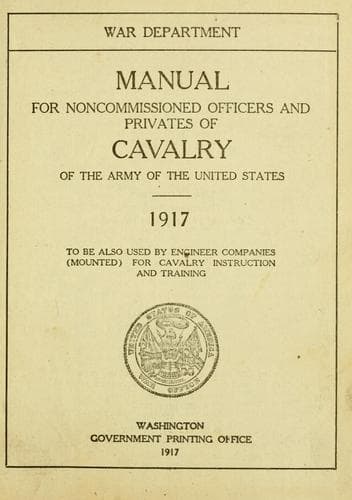
Manual for Noncommissioned Officers and Privates of Cavalry of the Army: of the United States 1917. To be also used by Engineer Companies (Mounted) for Cavalry Instruction and TrainingUnited States. War Department
History
Manual for Noncommissioned Officers and Privates of Cavalry of the Army: of the United States 1917. To be also used by Engineer Companies (Mounted) for Cavalry Instruction and Training
United States. War Department
United States. Army -- Handbooks, manuals, etc.
=649.= The captain gives any desired special instructions to the
guidon and sees that proper measures for security are taken. On
dismounting, the first sergeant remains near the horses long enough to
see that the designated noncommissioned officer is in charge and is
making proper provision as regards the horses; he then joins the
captain. Any sergeants who may be extra file closers without special
assignment of duties join the captain; other extra file closers not
specially assigned join the platoons with which they were riding. The
captain, on dismounting, takes position at the point where he desires
the base platoon to form or otherwise indicates that position to the
leader of the base platoon. The platoon that was the base when the
troop dismounted remains the base of the dismounted formation in the
absence of other indication. Its leader takes position at once in rear
of the captain, or as indicated by the latter, and the dismounted
platoon forms in =double column= or as directed. The other platoons
form so as to extend the formation =in line of double columns=, or as
the captain orders, in accordance with the principles governing the
assembly of the troop. The captain may direct the platoon leaders to
proceed at once to designated positions without forming the troop as a
unit. _In all cases the measures taken must be such as to prevent
unnecessary exposure of men or horses to hostile view or fire._
DISMOUNTED COMBAT (THE TROOP).
GENERAL CONSIDERATIONS.
=650.= When the troop, acting alone, dismounts to engage in deliberate
fire action the captain makes provisions for the led horses (par. 649)
and at once sends out scouts (usually two experienced men detailed and
trained as such) to the front to reconnoiter. The captain reconnoiters
usually in rear of, but in touch with the scouts, and accompanied by
platoon commanders and the first sergeant; he explains to them the
purpose of the attack, gives them all the information he has about the
enemy and about our own troops in the vicinity, points out to them the
objective of each platoon if they are to advance, or indicates the
part of the line to be held by each if to take the defensive.
Public-domain text, read in full here on John Shaqi.
Reviews
Reviews
No reviews yet
Be the first to share your thoughts on this work.
Elsewhere in the archive
Join the Discussion
Join the discussion
Sign in to leave a comment or review.
Sign InorCreate an account