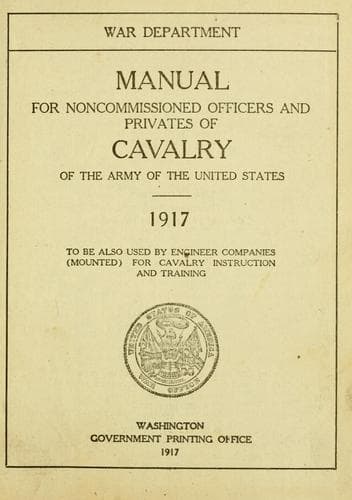
Manual for Noncommissioned Officers and Privates of Cavalry of the Army: of the United States 1917. To be also used by Engineer Companies (Mounted) for Cavalry Instruction and TrainingUnited States. War Department
History
Manual for Noncommissioned Officers and Privates of Cavalry of the Army: of the United States 1917. To be also used by Engineer Companies (Mounted) for Cavalry Instruction and Training
United States. War Department
United States. Army -- Handbooks, manuals, etc.
=651.= The advance of a troop after dismounting, in anticipation of
fire action either in attack or defense is made in close order,
preferably in columns of fours or twos, until the probability or the
actual encountering of hostile fire makes it advisable to deploy.
After such deployment the advance (now designated =the approach=) may
be continued in line of skirmishers or other suitable formation before
opening fire. The approach dismounted may often be facilitated, better
advantage taken of cover, and losses minimized by using formations
such as line of platoons each in column of twos or troopers, or a
succession of thin lines at varying distances, one directly behind the
other or echeloned. The choice of a formation would depend upon
conditions, such as the effectiveness of the enemy's fire, cover
afforded by folds of the ground, or by natural obstacles. If the
deployment is found to be premature, it will generally be better to
assemble the troop and resume the advance in close order.
The formations mentioned as facilitating the advance, viz, line of
platoons in column of twos or troopers, or a succession of thin lines
find application most frequently in the approach when the ground is so
difficult or the cover so limited as to make it desirable to take
advantage of the few favorable routes on which to move forward.
=652.= The approach in a succession of thin lines is, if possible,
made by sections under the immediate direction of platoon commanders
with wide intervals between skirmishers. By so advancing continuous
control of the line is assured. If that method is not practicable,
then the successive lines are made up of one or more men from each
four of a platoon on the skirmish line, the command being: 1. =Numbers
1 (or such number or numbers), first (or such) platoon, forward=; 2.
=MARCH.=
The captain having pointed out in advance the selected position in
front of the lines which are to be occupied, the designated numbers
move to the front. The line thus formed preserves the original
intervals as nearly as practicable; when this line has advanced to the
indicated position, a second line is sent forward by similar commands,
and so on at irregular distances until the whole line has advanced.
Upon arriving at the indicated position the first line is halted.
Successive lines upon arriving halt on line with the first, and the
men take their proper places in the skirmish line.
Ordinarily each line is made up of one man or more from each four of a
platoon, and the men of a four are sent forward in order from right to
left. The first line is led by the platoon leader of that platoon, the
second by its file closer, and so on. Under favorable conditions the
successive lines may be made up from all of the platoons which are
deployed as skirmishers.
The movement is conducted in quick time unless conditions make double
time necessary.
After the entire troop has reached the line a further advance in the
same manner may be found advisable.
Public-domain text, read in full here on John Shaqi.
Reviews
Reviews
No reviews yet
Be the first to share your thoughts on this work.
Elsewhere in the archive
Join the Discussion
Join the discussion
Sign in to leave a comment or review.
Sign InorCreate an account