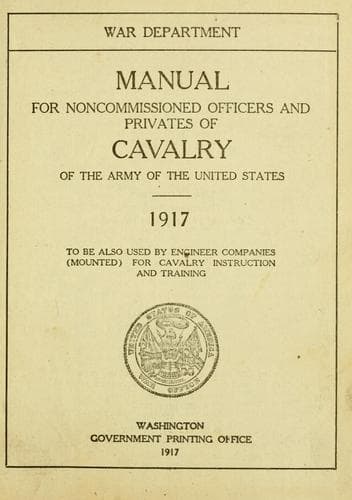
Manual for Noncommissioned Officers and Privates of Cavalry of the Army: of the United States 1917. To be also used by Engineer Companies (Mounted) for Cavalry Instruction and TrainingUnited States. War Department
History
Manual for Noncommissioned Officers and Privates of Cavalry of the Army: of the United States 1917. To be also used by Engineer Companies (Mounted) for Cavalry Instruction and Training
United States. War Department
United States. Army -- Handbooks, manuals, etc.
As a rule not more than one-third of the support should be on outguard
duty. As soon as they are sent out to their positions the support
commander selects a defensive position on the line of resistance;
gives instruction for intrenching same; establishes a sentinel to
watch for and transmit signals from outguards; sends out patrols to
reconnoiter the country to the front of his section and, if on the
flank of the line, the flank; and then proceeds to make a careful
reconnoissance of the section assigned him, rectifying the position of
outguards if necessary, seeing that they understand their instructions
in case of attack or when strangers approach their posts, and pointing
out their lines of retreat in case they are compelled to fall back on
the support.
When the outguards are established, the members of the support may
stack arms and remove equipment except cartridge belts. Part of the
horses may be unsaddled and groomed and fed at one time. All girths
should be loosened. No fires will be built or smoking permitted unless
specially authorized, or no loud talking or other noise. All
patrolling to the front will be done, as a rule, from the support. The
support commander should locate the position of the adjacent supports
and make arrangements with the commanders for the joint defense of the
line of resistance. At nights all roads and trails should be carefully
covered and the country to the front and between adjacent outguards
well patrolled. Horses should, as far as possible, be permitted to
rest, unsaddled, at night.
The line occupied by the outguards is called the line of observation.
Outguards move to their positions providing for their own protection
and so as to conceal the movement from the enemy. These positions are
intrenched and are numbered from right to left in each support.
The duties of the outguard are to observe the enemy, to guard the
outpost from surprise, and to make a preliminary resistance to the
enemy's advance. The strength of the outguard will vary according to
its object. When an important road, which at night will afford a line
of advance, or a bridge is to be covered, or when several posts are
established from an outguard it should be of considerable strength, a
section or a platoon. When mere observation and alarm are all that is
required four men will suffice. One corporal and seven privates are a
good number to use as an outguard; this will allow one double sentry
post of three reliefs and one man in addition to the commander, who
may be used for messenger service. The outguard should be carefully
concealed.
Public-domain text, read in full here on John Shaqi.
Reviews
Reviews
No reviews yet
Be the first to share your thoughts on this work.
Elsewhere in the archive
Join the Discussion
Join the discussion
Sign in to leave a comment or review.
Sign InorCreate an account