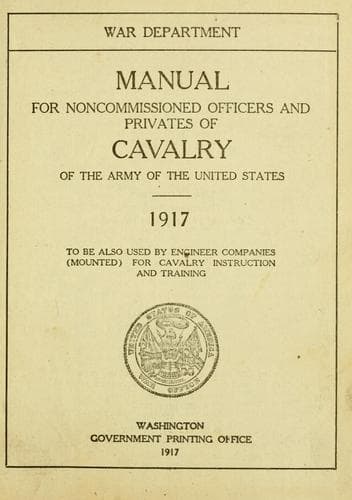
Manual for Noncommissioned Officers and Privates of Cavalry of the Army: of the United States 1917. To be also used by Engineer Companies (Mounted) for Cavalry Instruction and TrainingUnited States. War Department
History
Manual for Noncommissioned Officers and Privates of Cavalry of the Army: of the United States 1917. To be also used by Engineer Companies (Mounted) for Cavalry Instruction and Training
United States. War Department
United States. Army -- Handbooks, manuals, etc.
As a rule an outpost will not exceed one-sixth the strength Of a
command. For a single troop a few sentinels and patrols will suffice;
for a larger command a more elaborate system must be devised. The
troops composing the outpost are generally divided into a reserve and
several supports.
At a proper distance in front of the camp of the main body a line
which offers a good defensive position is selected. This is called
=the line of resistance=, and should be so located that an advancing
enemy will be held in check beyond effective rifle range in case of a
small force, artillery range in case of a large force, of the main
body until the latter can deploy. The reserve is stationed at some
point in rear of this line, where it can be moved quickly to reinforce
any point as needed. The line of resistance is divided into sections,
the limits of each of which are clearly defined. A support is assigned
to each section, which are numbered from right to left, and occupies a
position on or near the line, having special regard to covering
avenues of approach. The position occupied should always be
intrenched. The reserve and supports proceed to their respective
positions by the shortest routes, providing for their own protection
by sending out covering detachments.
Generally speaking, about one-half the Infantry of the advance guard
should be in the supports. As each support arrives at its position it
sends out observation groups, varying in size from four men to a
platoon, to watch the country in the direction of the enemy. These
groups are called outguards. For convenience they are classified as
pickets, sentry squads, and cossack posts, and should be sufficient in
number to cover the front of the section occupied by the support and
connect with the neighboring supports. The horses of the outguards
may be left at the position of the support.
A picket is a group consisting of one or two sections, ordinarily not
exceeding half a company, posted in the line of outposts to cover a
given sector. It furnishes patrols and one or more sentinels, sentry
squads, or cossack posts for observation. Pickets are placed at the
more important points in the line of outguards, such as road forks.
The strength of each depends upon the number of small groups required
to observe properly its sector.
A sentry squad is a squad (eight men) posted in observation at an
indicated point. It posts a double sentinel in observation, the
remaining men resting near by and furnishing the reliefs of sentinels.
In some cases it may be required to furnish a patrol.
A cossack post consists of four men. It is an observation group
similar to a sentry squad, but employs a single sentinel.
Public-domain text, read in full here on John Shaqi.
Reviews
Reviews
No reviews yet
Be the first to share your thoughts on this work.
Elsewhere in the archive
Join the Discussion
Join the discussion
Sign in to leave a comment or review.
Sign InorCreate an account