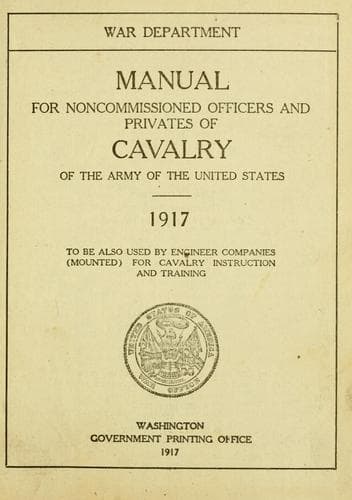
Manual for Noncommissioned Officers and Privates of Cavalry of the Army: of the United States 1917. To be also used by Engineer Companies (Mounted) for Cavalry Instruction and TrainingUnited States. War Department
History
Manual for Noncommissioned Officers and Privates of Cavalry of the Army: of the United States 1917. To be also used by Engineer Companies (Mounted) for Cavalry Instruction and Training
United States. War Department
United States. Army -- Handbooks, manuals, etc.
A sentinel on the line of observation should always have the following
instructions: The names of villages, streams, and prominent features
in sight and where the roads lead. The number (if any) of his post,
and the number of his and of the adjoining outguards; the position of
the support; the line of retreat to be followed if the outguard is
compelled to fall back; the position of advance detachments and
whether friendly patrols are operating in front; to watch to the front
and flanks without intermission and devote special attention to
unusual or suspicious occurrences; if he sees indications of the
enemy, to at once notify his immediate superior; in case of imminent
danger, or when an attack is made, to give the alarm by firing
rapidly; by day to pass in or out officers, noncommissioned officers,
and detachments recognized as part of the outposts, and officers known
to have authority to do so; to detain all others and notify the
outguard commander; at night, when persons approach his post, to come
to a ready, halt them, and notify the outguard commander; the latter
challenges, ascertains their identity, and acts accordingly. When
individuals fail to halt, or otherwise disobey, to fire upon them
after a second warning, or sooner if they attempt to attack or escape;
to require deserters to lay down their arms, and remain until a patrol
is sent out to bring them in; to order deserters pursued by the enemy
to drop their arms and to give an alarm; if they fail to obey they are
fired upon; to require bearers of flags of truce and their escorts to
halt and to face outward; to permit them to hold no conversation and
to see that they are then blindfolded and disposed of in accordance
with instructions from the support commander; if they fail to obey to
fire upon them; at night, to remain practically stationary, moving
about for purposes of observation only; not to sit or lie down unless
authorized to do so; in the daytime, to make use of natural or
artificial cover and assume such positions as to give him the best
field of view; to inform passing patrols of what he has seen; to carry
his weapon habitually loaded and locked and at will.
Public-domain text, read in full here on John Shaqi.
Reviews
Reviews
No reviews yet
Be the first to share your thoughts on this work.
Elsewhere in the archive
Join the Discussion
Join the discussion
Sign in to leave a comment or review.
Sign InorCreate an account