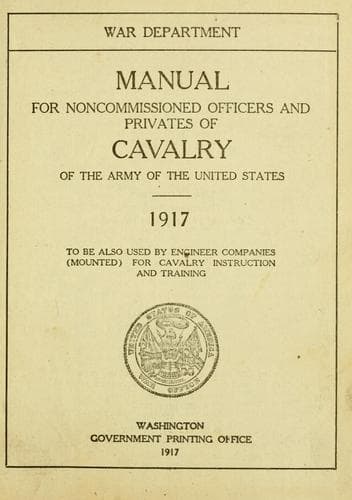
Manual for Noncommissioned Officers and Privates of Cavalry of the Army: of the United States 1917. To be also used by Engineer Companies (Mounted) for Cavalry Instruction and TrainingUnited States. War Department
History
Manual for Noncommissioned Officers and Privates of Cavalry of the Army: of the United States 1917. To be also used by Engineer Companies (Mounted) for Cavalry Instruction and Training
United States. War Department
United States. Army -- Handbooks, manuals, etc.
Outpost patrols are divided into those which operate beyond the lines
and those whose duty lies principally within the lines. The former,
called reconnoitering patrols, scout in the direction of the enemy;
the latter, called visiting patrols, maintain communication between
the parts of the outpost and supervise the performance of duty on the
line of observation. Reconnoissance should be continuous. Though
scouts and detachments of cavalry remain in contact with the enemy, or
at least push forward to a considerable distance, more detailed
reconnoissance by infantry patrols in the foreground must not be
neglected. Reconnoitering patrols are composed of at least two men and
a skillful leader, who, in important cases, would be an officer. They
obtain information, ascertain the presence of the enemy, or discover
his approach. All patrols, when they cross the line of observation,
inform the nearest sentinel of the direction in which they are to
advance; on their return they similarly report what they have seen of
the enemy; signals are agreed upon so that they can be recognized when
returning. Any ground near the line of observation which might afford
cover for troops, or for scouts or spies, and the approach to which
can not be observed by sentinels, is searched frequently by patrols.
Definite information concerning the enemy is reported at once. Patrols
fire only in self-defense or to give the alarm. Supports on the flank
of an outpost position patrol the country on the exposed flank.
Visiting patrols and reliefs should not march in the open and thereby
expose the position of sentinels.
During a march in the vicinity of the enemy when halts are made,
special measures for protection are taken. When the halt is for a
short period, less than half an hour, the advance party and support
remain at ease, the point and flankers move to positions from which
they can obtain a good lookout, and additional patrols may be sent out
from advance parties and supports. Where the halt is for a period
exceeding half an hour a =march outpost= should be formed.
With an advance guard consisting of a squadron, one troop as support
and three as reserve, a suggested form of march outpost might be
formed as follows: The leading platoon moving to the front at a trot
for 400 yards would be outguard No. 2; the next platoon in rear,
moving to the right at a trot for about 600 to 800 yards would be
outguard No. 1; the next platoon, moving to the left in the same
manner would be outguard No. 3; and the 4th platoon would be the
support of the march outpost. The reserve (3 troops) would be the
reserve of the march outpost. On signal being given to resume the
march, the various units would close in at a trot or gallop, and as
soon as the support had assembled the march would be resumed.
=Section 8. Rifle trenches.=
Public-domain text, read in full here on John Shaqi.
Reviews
Reviews
No reviews yet
Be the first to share your thoughts on this work.
Elsewhere in the archive
Join the Discussion
Join the discussion
Sign in to leave a comment or review.
Sign InorCreate an account