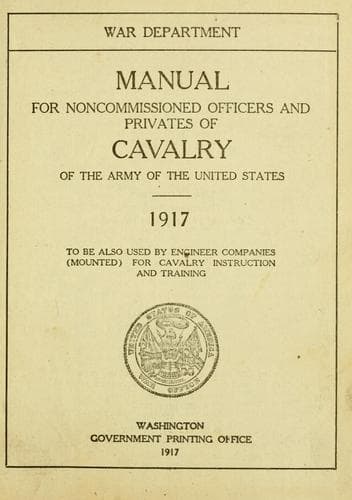
Manual for Noncommissioned Officers and Privates of Cavalry of the Army: of the United States 1917. To be also used by Engineer Companies (Mounted) for Cavalry Instruction and TrainingUnited States. War Department
History
Manual for Noncommissioned Officers and Privates of Cavalry of the Army: of the United States 1917. To be also used by Engineer Companies (Mounted) for Cavalry Instruction and Training
United States. War Department
United States. Army -- Handbooks, manuals, etc.
The commander of the guard should be given a memorandum as to what
time to awaken the cooks and where their tent is. The member of the
guard who does this should awaken them without noise, so as not to
disturb the rest of the remainder of the command.
The cooks should be instructed as to what time breakfast is to be
served and what time to awaken the first sergeant.
The cooks or cooks' police must cut and split all firewood for the
morning before 9 p. m. There must be no chopping, talking, or rattling
of pans before reveille which will disturb the rest of the command.
This applies to every morning in camp.
THE MORNING OF THE MARCH.
Cooks arise when called by the guard and start the preparation of
breakfast without noise. The first sergeant and stable sergeant are
usually awakened by one of the cooks about half an hour before
reveille in order that they may complete their toilets and breakfast
early and be able to devote all their time to supervising the details
of the morning's work. If the officers desire to be awakened before
reveille they will notify the first sergeant accordingly.
At first call the men turn out, perform their toilets, strike their
shelter tents (unless it has been directed to await the sounding of
the general for this), and make up their packs. The stable detail
feeds the horses.
At the sounding of assembly immediately after reveille each man must
be in his proper place in ranks, except the kitchen and stable details
who are actually at work. This assembly is under arms. The first
sergeant starts to call the roll or commands "Report" at the last note
of assembly. Arms are stacked before the troop is dismissed.
Breakfast is served to the troop immediately after roll call.
Immediately after breakfast each man will wash his mess kit in the hot
water provided for that purpose at the kitchen and will at once pack
the mess kit in his saddlebags.
The cooks will provide hot water for washing mess kits at the same
time that breakfast is served.
Immediately after breakfast the troop proceeds to the work of breaking
camp and packing in accordance with a prearranged system similar to
the following:
One section assists the cooks in packing the kitchen.
One section strikes and folds the officers' tents and brings them to
the kitchen.
One section fills in the sink. The sink should not be filled in
earlier than is absolutely necessary.
The stable detail police the picket line and vicinity.
One section polices the camp within the company police limits.
One section is available for possible details from regimental
headquarters.
Officers and first sergeant supervise the work.
A permanent assignment of squads to these duties lightens the labor
and decreases the time necessary for breaking camp.
=Boots and saddles= should not be sounded before all of the above work
has been completed, and without confusion. Don't begin the day by
nagging your men, thereby making them "grouchy" during the march.
Public-domain text, read in full here on John Shaqi.
Reviews
Reviews
No reviews yet
Be the first to share your thoughts on this work.
Elsewhere in the archive
Join the Discussion
Join the discussion
Sign in to leave a comment or review.
Sign InorCreate an account