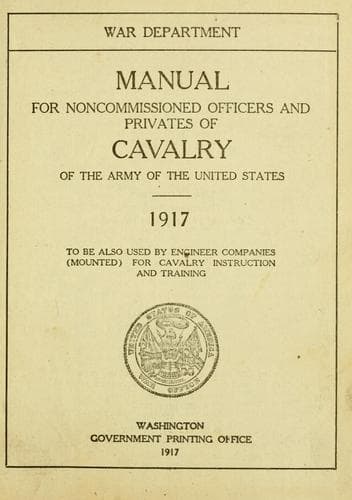
Manual for Noncommissioned Officers and Privates of Cavalry of the Army: of the United States 1917. To be also used by Engineer Companies (Mounted) for Cavalry Instruction and TrainingUnited States. War Department
History
Manual for Noncommissioned Officers and Privates of Cavalry of the Army: of the United States 1917. To be also used by Engineer Companies (Mounted) for Cavalry Instruction and Training
United States. War Department
United States. Army -- Handbooks, manuals, etc.
To obtain head cover in a trench fill a gunny sack or other bag with
sand or soil and place it on top of the parapet, aiming around the
right-hand side of it, or dig a small lateral trench in the parapet,
large enough to hold the rifle. Roof it over with boards, small logs,
or brush, and heap dirt on top, aiming through the small trench or
resulting loophole.
Figure 5 shows the plan of a section of a rifle trench.[10] Between
the portions occupied by each squad there is often placed a mound of
earth as high as the top of the parapet and projecting back into the
trench. This is called a =traverse= and protects the occupants of the
trench from fire from a flank. Bullets from this direction hit a
traverse, instead of flying down into the trench and wounding several
men.
[Footnote 10: The traverse should be at least 6 feet wide
instead of 3 feet, as shown in figure 5.]
Trenches are seldom continuous, but are made in sections placed at the
most advantageous points, as shown in figure 6. A company or battalion
may occupy a single section. The firing trenches have cover trenches
in rear of them, where the supports can rest undisturbed by the
hostile fire until they are needed in the firing trench to repel a
serious assault or to take part in a counter attack. Passages
consisting of deep communicating trenches facilitate passage from the
cover trenches to the firing trenches when under fire. These
communicating trenches are usually zigzag or traversed to prevent
their being swept by hostile fire.
When troops are likely to remain in trenches for a considerable time
drainage should be arranged for, and latrines and dressing stations
should be constructed in trenches. Water should be brought into the
trenches and holes excavated in the front wall of the trench for extra
ammunition.
In digging trenches men usually work in reliefs, one relief digging
while the others rest, the proportion of shovelers to pickmen being
about 3 to 1. If a plow can be obtained to turn the sod, it will
greatly facilitate the initial work of digging.
[Illustration: Fig. 1, Fig. 2, Fig. 3, Fig. 4, Fig. 5, Fig. 6, Plate
V.]
CHAPTER VII.
MARCHING AND CAMPING.
=Section 1. Breaking camp and preparation for a march.=
THE EVENING BEFORE THE MARCH.
When a command learns that it is to make a march on the following day,
presumably starting early in the morning, certain details should be
attended to the evening before.
All men should fill their canteens, as there will probably be no time
for this in the morning.
The mess sergeant should find out whether lunch or the reserve ration
will be carried on the march, and should attend to these details in
the evening in order that the issue can be made promptly in the
morning.
The stable sergeant will have the stable detail fill all of the feed
bags for the morning's feed, and the section leaders will see that
each of their men has filled his grain bag with the noon feed for the
following day.
Public-domain text, read in full here on John Shaqi.
Reviews
Reviews
No reviews yet
Be the first to share your thoughts on this work.
Elsewhere in the archive
Join the Discussion
Join the discussion
Sign in to leave a comment or review.
Sign InorCreate an account